Foreigners discover the value of Chaekgeori paintings first
Among the genres of paintings popular during the late Joseon dynasty is the genre of Chaekgeori painting, a still-life painting of various scholarly accoutrements, books, and artifacts. Interestingly, Chaekgeori paintings did not receive much attention from the South Korean academic community or public and remained along the sidelines for a long time. This was because male scholar-officials of the Joseon period, who led mainstream trends of culture at the time, mainly valued calligraphy or traditional East Asian landscape paintings (sansuhwa) to express their academic achievements and artistic spirit. Of course, there were more practical paintings such as folding screens used during Confucian rituals or for spatially decorative purposes within the scholar-official tradition; these, however, were part of a genre produced by court painters at the Royal Academy of Painting (Dohwaseo) or professional painters and therefore were not fully appreciated as an independent genre through which painters could realize their artistic ideas.
Against this backdrop, Chaekgeori paintings were also seen as a kind of folk painting (minhwa) for a long time and dismissed as mere cheap decorative craft. In fact, it was foreign scholars who first discovered the unique value of Chaekgeori paintings: Edward W. Wagner, a Professor Emeritus at Harvard University, and Kay E. Black, an art historian. Among the most notable achievements of their collaboration were the series of pioneering papers published during the 1990s and their joint contribution to the catalog for the 1998 exhibition “Hopes and Aspirations: Decorative Painting of Korea” that was held at the Asian Art Museum of San Francisco and introduced major Chaekgeori paintings. Through the gaze of foreigners, the hidden treasures of Korean art finally began to be brought to light.
Recent trends in research, lectures, and exhibitions on Chaekgeori paintings
The exhibition “Chaekgeori: Pleasures of Possessions in Korean Painted Screens” that embarked on a US traveling tour from 2016 to 2017 marked a monumental milestone for the genre. Bringing together prominent researchers and curators active in their fields both within and outside of South Korea, this was a standalone exhibition consisting only of Chaekgeori painting held in the United States. Traveling to a total of three institutions—Charles B. Wang Center at Stony Brook University, New York; Spencer Museum of Art at the University of Kansas; and the Cleveland Museum of Art, Ohio—this traveling exhibition provided the American public with a new, multilayered way to view Korean art. Thanks to the book published after the tour, Chaekgeori: The Power and Pleasure of Possessions in Korean Painted Screens, co-edited by Byungmo Chung, who taught at Gyeongju University, and Sunglim Kim, currently at Dartmouth College, the uniquely Korean term Chaekgeori was able to become established as a fully professional term in American academic and art communities.
This exhibition also served as a turning point for me. Since then, I have made Chaekgeori paintings an important theme of the special lectures I give that introduce Korean art overseas. For instance, I have shared the charm and appeal of Chaekgeori paintings with local students during the lectures given at the Fashion Institute of Technology (FIT), State University of New York, USA; the University of Pécs, Hungary; and Leipzig University, Germany. Between 2023 and 2025, I delivered the lecture “Joseon Society, History, Economy, and Commerce Through Chaekgeori” during the Academy of Korean Studies (AKS) Summer Program for International Students. This three-week program is targeted towards international university students interested in learning the Korean language and experiencing its culture firsthand and ultimately aims to foster future scholars of Korean Studies around the world.
Among the several themes I give lectures on, students tend to enthusiastically respond to and positively evaluate the sessions that introduce Chaekgeori paintings in particular. This is because instead of introducing them simply as works of art, I narrate the larger dynamics of social, cultural, diplomatic, and commercial changes marking the shift from the premodern period of Korea to its modern era through the genre of Chaekgeori paintings. The students are fascinated by the experience of encountering the history of Korea three-dimensionally from a global perspective through the visual media of art.
<Figures 1-3> Scenes of Special Lectures Overseas on Chaekgeori and Related Posters
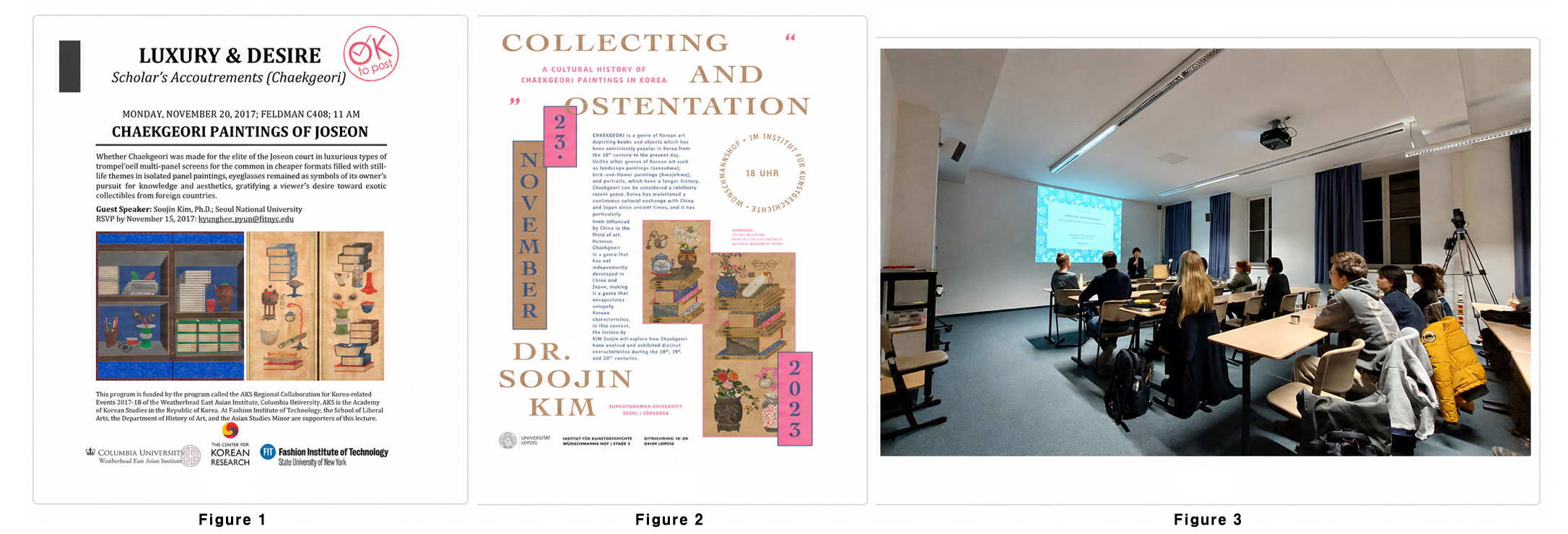
Figure 1. Poster of guest lecture delivered by author at FIT on November 15, 2017.
Figure 2. Poster of guest lecture delivered by author at Leipzig University on November 23, 2023.
Figure 3. Photograph of guest lecture delivered by author at Leipzig University on November 23, 2023.
Korean history and material culture read through changes in the genre of Chaekgeori paintings
The fact that Chaekgeori paintings, which are filled with depictions of books and luxury goods, were greatly popular in the late Joseon period is in itself an intriguingly ironic phenomenon. This was a Neo-Confucian society that strictly warned against falling into the trap expressed in the idiom “wan mul sang ji(玩物喪志),” or excessively and obsessively pursuing material goods and consequently losing the noble life purpose of learned men. Chaekgeori paintings, however, primarily feature dozens to hundreds of books, which were not items easily obtainable in the Joseon period such as today. The possession of books in a time when their production and distribution were extremely limited was a way to prove one’s superior financial means, high level of education, and prestigious social status.
In the early Joseon period, the state’s Royal Printing Agency (Gyoseogwan) and local government offices were the bodies that mostly issued books and distributed them to government officials and Confucian students or scholars. Rare books imported from China were treated with great care, as if they were precious treasures. Poorer learned men had to be content with handwritten copies they painstakingly made from borrowed books. Although the culture of possessing books spread to the middle people class (jungin) or wealthy commoners in tandem with the development of commerce in the Late Joseon, books still remained expensive valuables. Thus, depicting books bound in fancy silk covers in Chaekgeori paintings was an ostentatious act to show off one’s erudition, economic status, and cultural refinement.
<Figure 4> Folding Screen of Chaekgeori
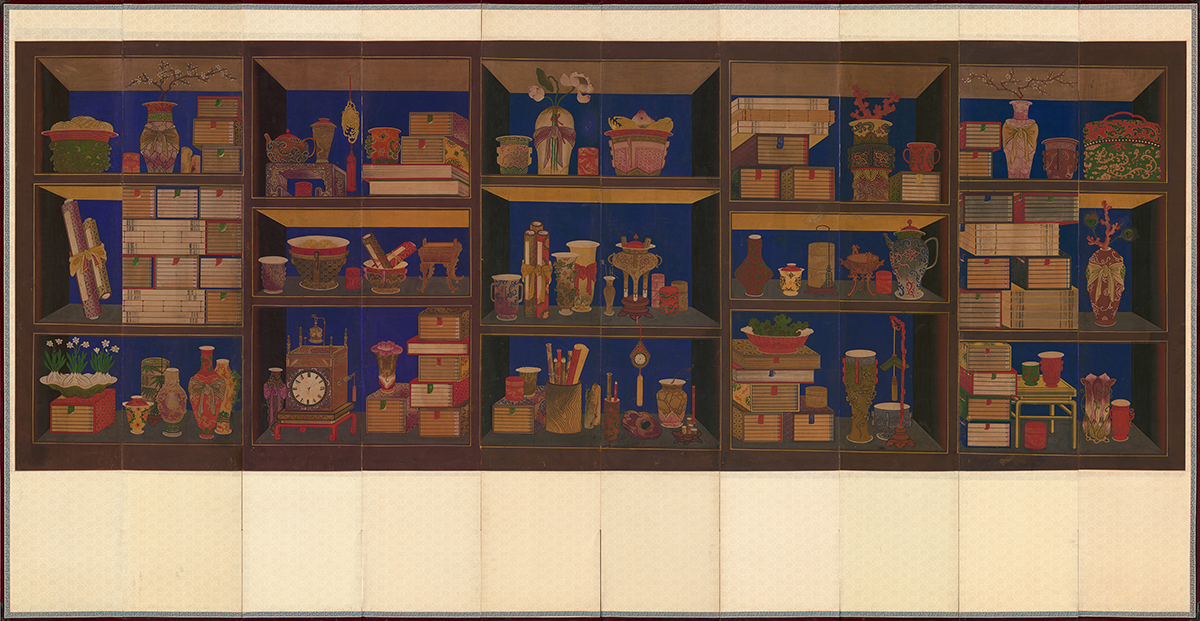
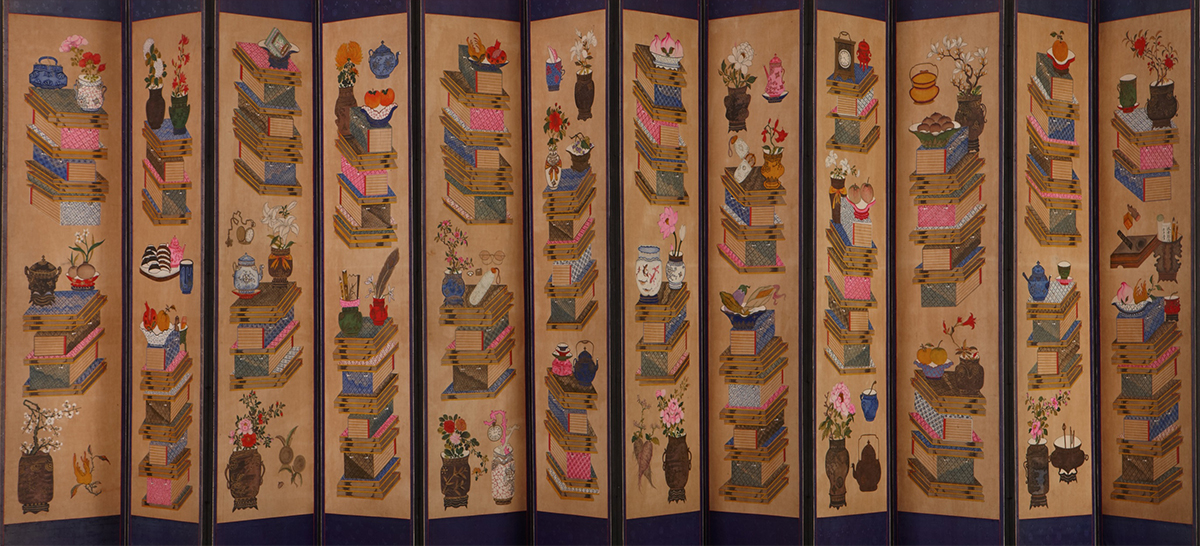
Source: Unidentified artist, Painting of Chaekgeori (also cataloged as Folding Screen of Chaekgado or Chaekgeorido), Joseon dynasty, 19th century, ink and color on silk, 131 x 386.4 cm (National Museum of Korea, Accession no. Dongwon 3322). This Chaekgeori painting is filled with colorful porcelain, including splendid Falangcai porcelain imported from China, and books bound in silk. The lower left section features a spring-driven mechanical striking table clock.
In addition to books, these Chaekgeori paintings portrayed a large number of rare, imported goods and expensive luxury items from overseas. When they first began to gain popularity in the 18th century mainly among the royal family, items including magnificent ceramics such as Falangcai porcelain and Western mechanical alarm clocks made by the finest artisans of the Qing imperial court depicted in the paintings immediately captured the viewers’ attention<Figure 4>. Later, as the genre spread among the common people, the material and subject matter of Chaekgeori paintings also took more various forms to cater to the class who enjoyed them. Cheaper pigments were used, for instance, and the size and scale of the paintings began to vary. The emergence of these popularized versions allowed more people to commission and enjoy them regardless of their hereditary social status or budget, shaping the culture surrounding Chaekgeori paintings.
These clocks and watches tended to feature a sub-seconds dial at the 6 o’clock position, which were models that began to be sold in the United States from the 1850s and were widely distributed in Korea during the 1920s and 1930s
<Figures 5-7> Modern Clocks in Chaekgeori Paintings and Newspaper Advertisements at the Time
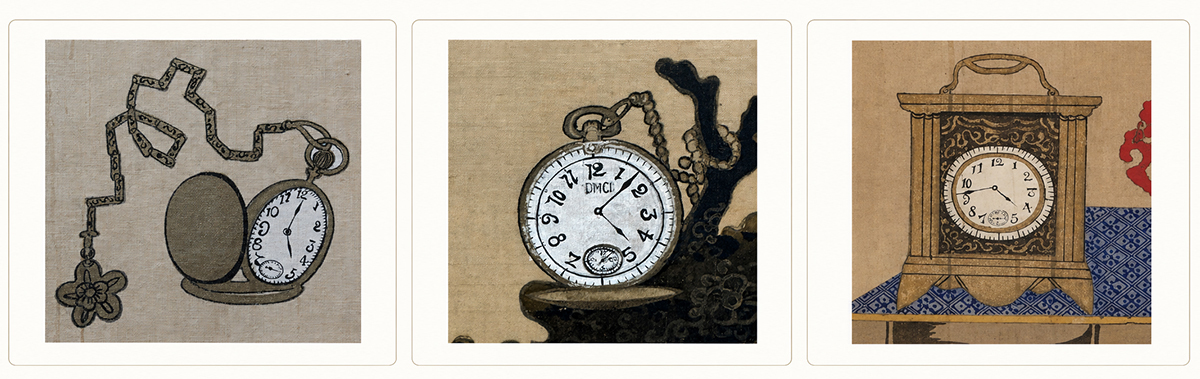
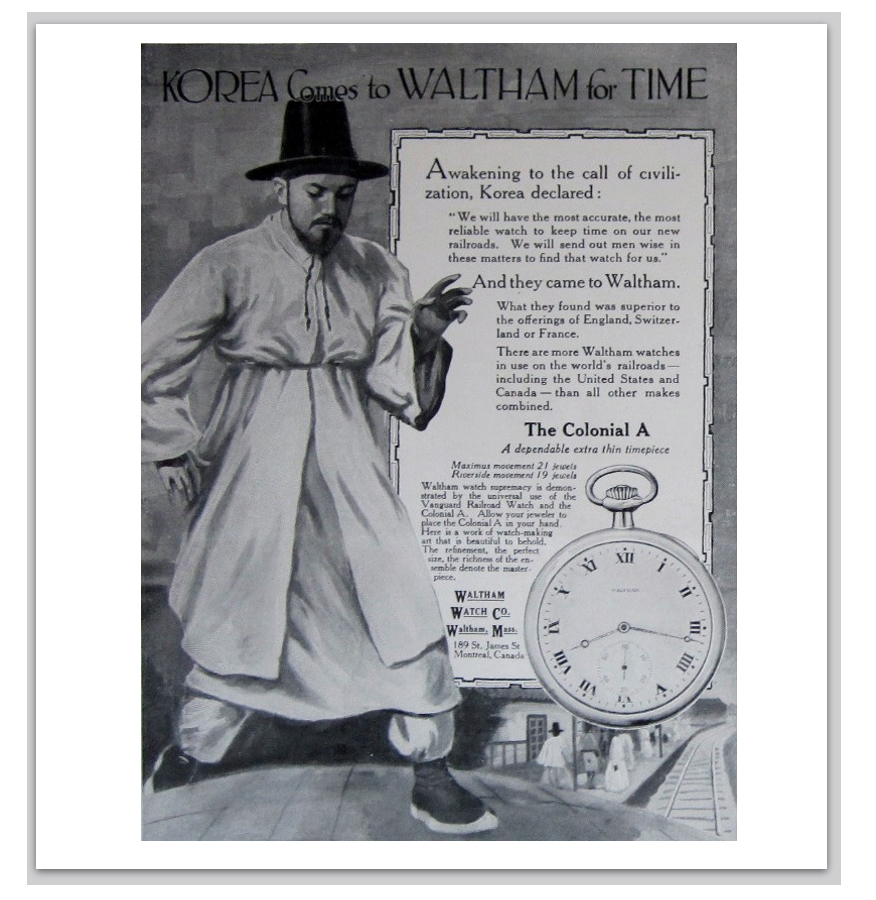
There is a scene in Korean history that comes to mind at this point. Yun Bong-gil, an independence movement activist under Japanese colonial rule, purchased a gold-colored Waltham pocket watch to ensure that he would be exactly on time for the planned bombing in Shanghai in 1932. According to Journal of Baekbeom Kim Gu (Baekbeom ilji), on the day of the planned attack, Yun Bong-gil swapped his watch with Kim Gu’s, persuading him that his newly bought watch was more expensive. Kim Gu cherished Yun Bong-gil’s watch until his own death, and this pocket watch was later designated National Registered Cultural Heritage No. 441. At the time, the American watch company Waltham was delivering modern civilization in the form of tens of millions of watches all around the world, and these waves of civilization had traveled to reach even the Chaekgeori paintings in the studies of Joseon <Figure 8>.
<Figure 8> National Registered Cultural Heritage No. 441, “Baekbeom Kim Gu’s Pocket Watch”
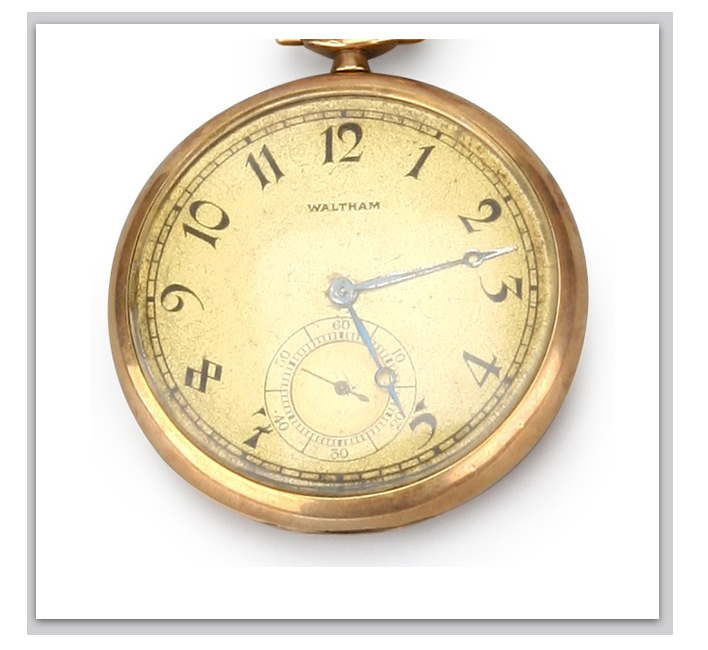
Description: Yun Bong-gil gave Kim Gu this pocket watch in the morning of the planned bombing attack of major Japanese and Manchukuo figures in Hongkou Park, Shanghai, China, on April 29, 1932. The watch face shows the logo of the American watch company Waltham.
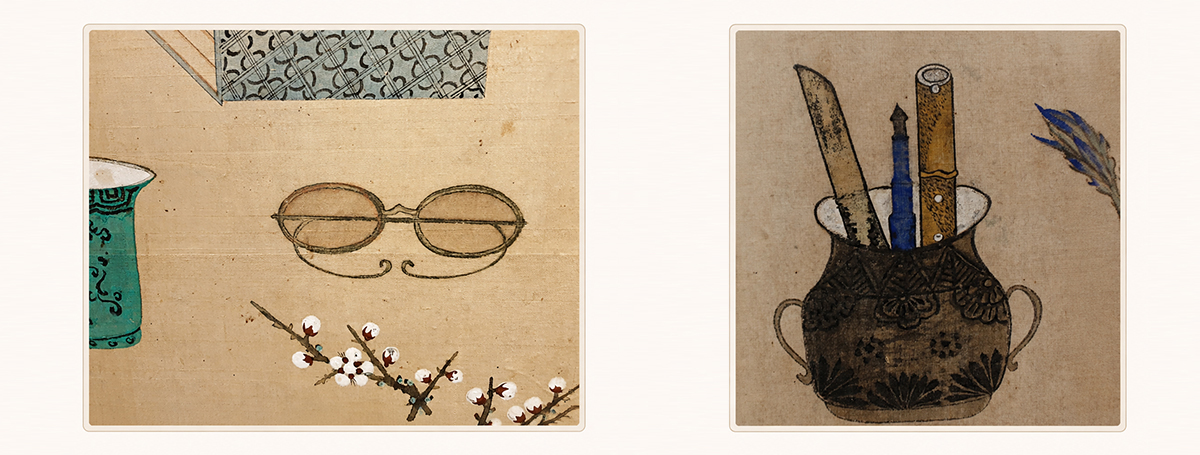
It is even possible to spot the trendy wire-rimmed spectacles, also called Windsor glasses, in Chaekgeori paintings, which were globally popular from the 1880s to the 1920s, instead of the traditional tortoiseshell eyeglasses carved from the shell of the hawksbill sea turtle called daemo in Korean. Meanwhile, the Waterman Pen Company, founded in 1884 by the American businessman Lewis E. Waterman, utilized capillary action to eliminate ink leakage, thereby opening the era of the mass production of fountain pens. Newspaper advertisements printed during the Korean Empire period and the list of imported goods during this time confirm that fountain pens imported from America and Europe were actively distributed and circulated among shops in the capital at the time. Such modern Western writing materials were organically taking the place of the so-called Four Friends of the Study—paper, brush, inkstick, and inkstone (mun bang sa u)—namely, traditional scholarly accoutrements (Figures 9-10).
<Figures 9-10> Wire-rimmed Spectacles and Fountain Pen Depicted in Chaekgeori Paintings
Furthermore, Chaekgeori paintings dating to the 20th century also feature women’s diamond rings, double rings for married women (garakji), and fancy jewelry boxes. Just like the way the diamond ring captured the Korean public through a single line in a novel even amid the dark reality of Japanese colonial rule, the Chaekgeori paintings are a snapshot of modern society at the time, where new, modern consumer culture was exploding. This shows how Chaekgeori paintings, which had started out as a representation of the scholars’ study—an exclusively male space for scholar-officials of Joseon—expanded into a new space of cultural interpretation that broke down boundaries of gender and class as the paintings became popularized
<Figures 11-12> Wire-rimmed Spectacles and Rings Featured in Chaekgeori Paintings
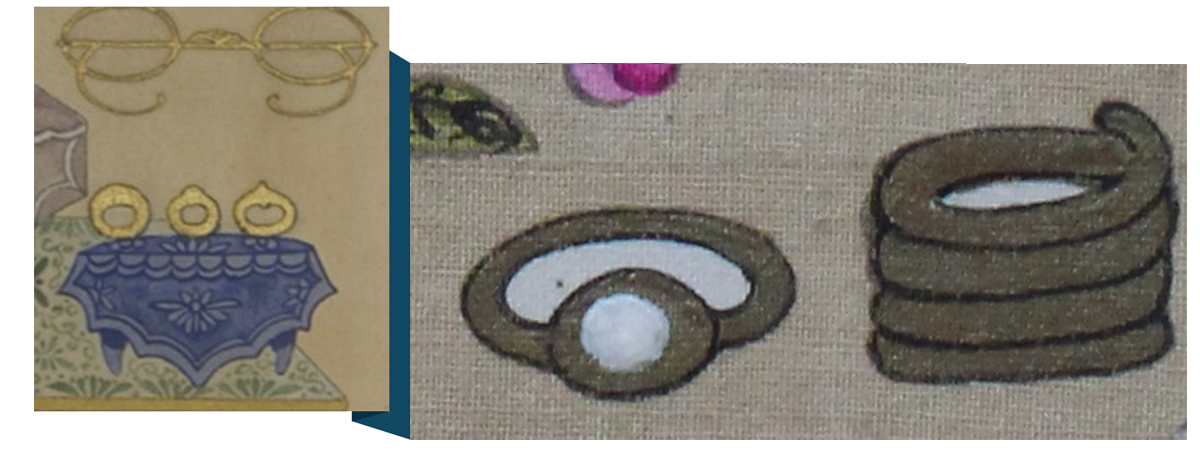
From the point of view focusing on material culture, all these items such as fountain pens, pocket watches, wire-rimmed spectacles, and diamond rings were goods that flowed into Korea via the global market after being mass produced in the West. With them entered notions of industry, capital, commerce, and trade. In short, the single genre of Chaekgeori paintings encapsulates the history of this massive upheaval in Korea, when the traditional Sinocentric worldview was dismantled while the new Western-centric global market opened up.
In search of authentic “Koreaness”
Whenever I am giving lectures introducing Korean art to students around the world, I always find myself faced with two fundamental questions: one is about identity—“What is ‘Koreaness’?”—and the other is about the prospects of traditional art—"Where is the future of traditional Korean art heading?”
The genres of art that were the most revered throughout the Joseon dynasty were undoubtedly literati calligraphy and landscape paintings. These were mainstream art reflecting the intellectual ideologies and moral values honored by the ruling class of male scholar-officials. Chaekgeori paintings, however, were born from the hands of professional painters and spread among the common people, taking on the role as a vessel to hold the public’s free imagination and worldly desires that transcended hereditary social status and gender. Moreover, they vividly attest to the traces of changes in the global trade environment and diplomatic shifts surrounding Korea at the time.
This is exactly why foreign students became deeply fascinated by Chaekgeori paintings. The dynamic moment of history, when the shift from the Sinocentric century to a Western-centric modern era was taking place, lives and breathes in these paintings. Standing upon this historical foundation, Koreans today are living in the era of global K-culture, where Korean culture including K-art, K-food, and K-beauty are permeating the lives of people worldwide.
If Chaekgeori paintings of the past were windows towards the world through which the finest goods, culture, and civilization from around the world were accepted in a uniquely Korean way, Korean Studies and K-culture today is serving as a new bridge to communicate with the world through a Korean perspective. I hope this column functions as a meaningful signpost to all the readers including my fellow Korean Studies scholars that confirms the dynamicity of Korean art and its global connections. Like the open-minded perspective illustrated by Chaekgeori paintings, I will continue to strive to make Korean art and K-culture travel beyond the limits of time and space and become a window that ceaselessly stimulates new cultural imagination and deeply resonates with people around the world. To that end, my role will be to constantly communicate from new perspectives in my research and at the sites of education.