
★ Announcement 1. Call for Proposals: Understanding Korea Contest 2026
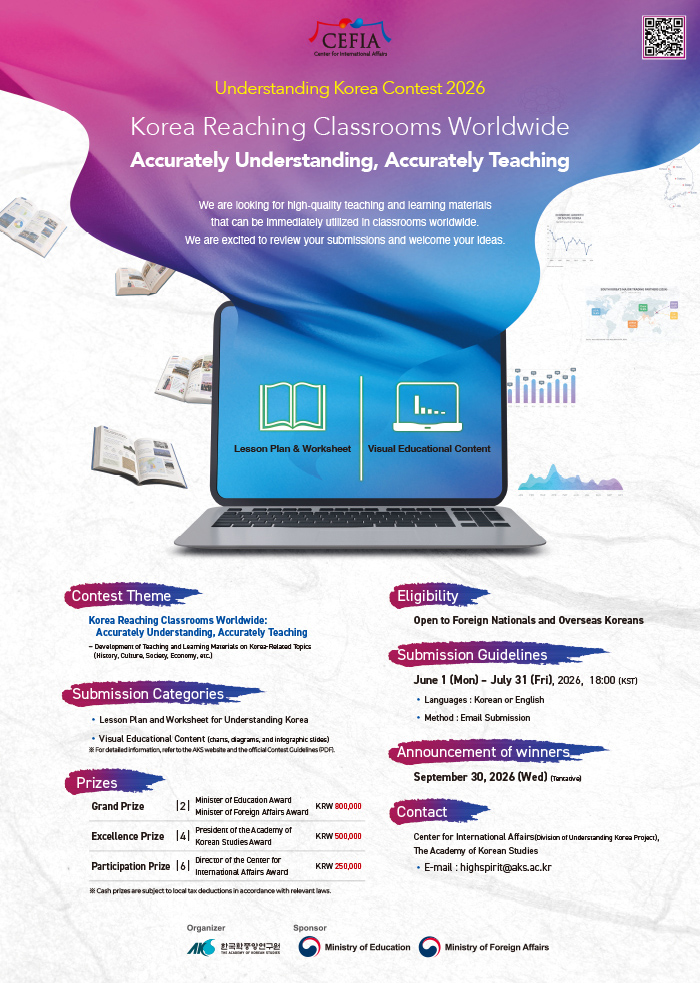
The Center for International Affairs at the Academy of Korean Studies (AKS) carries out the 'Understanding Korea Project,' which aims to improve and expand Korea-related content in foreign textbooks. For 2026, we are looking for high-quality teaching and learning materials that can be immediately utilized in classrooms worldwide. We are excited to review your submissions and welcome your ideas.
- A lesson plan consists of 1 or more class periods linked to the local curriculum
- Must include at least 1 worksheet
- Detailed proposal suitable for actual classroom use, including objectives, procedures, and evaluation methods
- Visual materials that illustrate Korea-related statistics, historical facts, or cultural characteristics (charts, diagrams, news cards, etc.)
- Standalone visual resources such as textbook illustrations, posters, or classroom summary materials
- Various digital tools, including generative AI, can be utilized
| Grand Prize | 2 winners | 800,000 KRW each |
| Excellence Award | 4 winners | 500,000 KRW each |
| Encouragement Award | 6 winners | 250,000 KRW each |
- Submission Period: June 1 (Mon) – July 31 (Fri), 2026, 18:00 (* Korean Standard Time, KST)
- Submission Language: Korean or English
- Submission Method: Via Email (highspirit@aks.ac.kr)
- Announcement Date:September 30, 2026 (Wed) Tentative
- Method: Email to highspirit@aks.ac.kr
E-mail: highspirit@aks.ac.kr ※ For inquiries regarding the contest, please contact us by e-mail.
2. The Academy of Korean Studies Participates as a Partner Organization in the 35th Annual Conference of the World History Association (WHA)
The Division of “Understanding Korea” Project under the Center for International Affairs at the Academy of Korean Studies is participating as a partner organization in the “35th Annual Conference” of the World History Association (WHA). This conference aims to strengthen cooperation with the network of US world history educators and promote exchanges in education and research related to Korea.
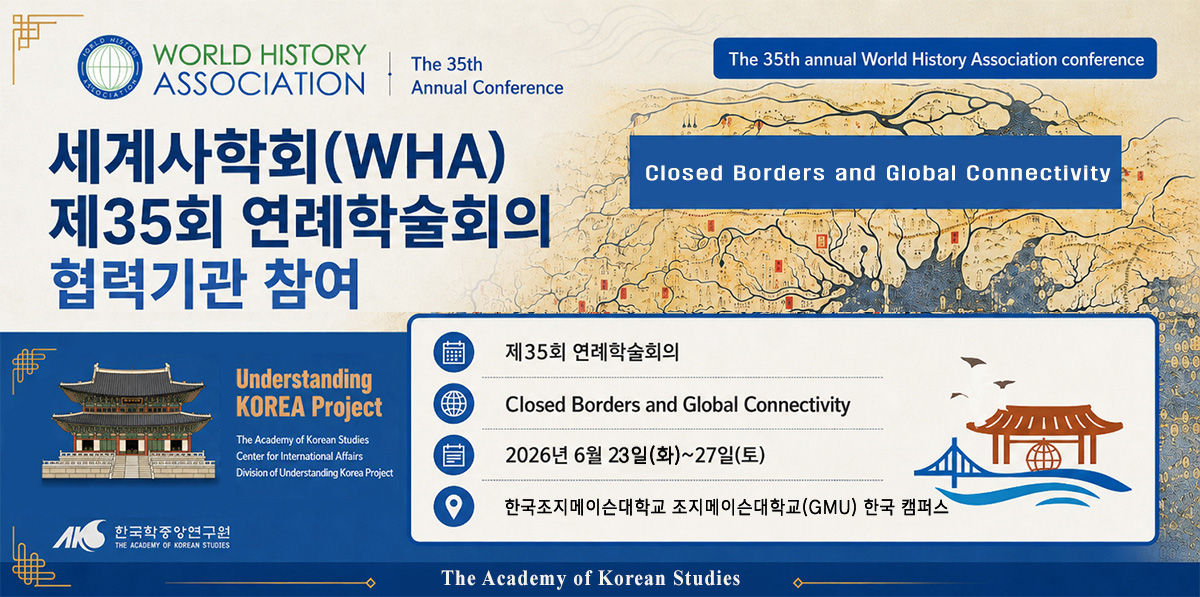
- ○ Theme: Closed Borders and Global Connectivity: Being Global after Globalization
- ○ Dates: June 23 (Tue) – June 27 (Sat), 2026
- ○ Venue: George Mason University (GMU) Korea Campus
- ○ Attendees: Approximately 250 U.S. world history educators
- ○ Main Activities: Korean culture training, sessions on Korea, and operation of exhibition booths, etc.
3. 2026 First Session of the <196th Overseas Korean Studies Colloquium>
The Division of International Support for Korean Studies under the Center for International Affairs at the Academy of Korean Studies successfully hosted the “196th Overseas Korean Studies Colloquium” online via Zoom on Thursday, June 11, 2026.
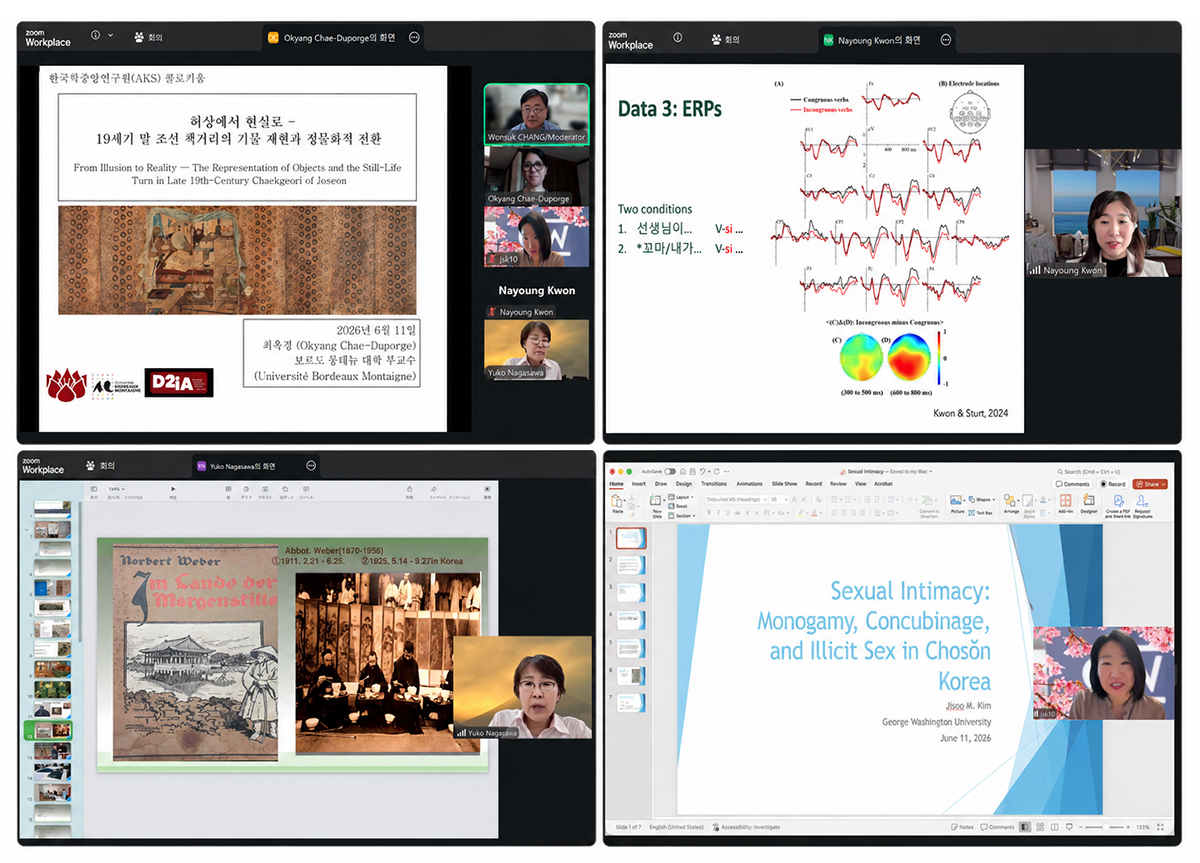
This event was organized to provide a platform for the Academy’s 2026 fellowship recipients to present their research findings and engage in in-depth academic exchanges with scholars from Korea and abroad. At this colloquium, a total of four researchers spanning various fields including art history, linguistics, and history delivered in-depth presentations.
Professor Choi Ok-kyung (University of Bordeaux Montaigne) analyzed changes in chaekgeori paintings and the transition to still-life paintings during the late Joseon period, while Professor Kwon Na-young (University of Oregon) compared and analyzed human language processing and the grammar acquisition process of Artificial Intelligence (AI) language models using Korean honorifics. Additionally, Researcher Yuko Nagasawa (Waseda University) introduced research on modern and contemporary Korean history from a transnational perspective, examining colonial rule, national division, and the Korean War from the viewpoints of Japanese and German scholars, while Professor Kim Ji-soo (George Washington University) examined the formation of sexual order and intimacy during the Joseon dynasty, focusing on monogamy, the concubinage system, and sexual crimes.
The question-and-answer session and discussion that followed the presentations saw the active participation of numerous researchers and graduate students from both Korea and abroad, leading to lively academic discourse. Attendees had a meaningful opportunity to explore the potential for interdisciplinary collaboration and review the latest international research trends.
4. 13th Classical Chinese Training Fellowship Graduation Ceremony Held in 2026
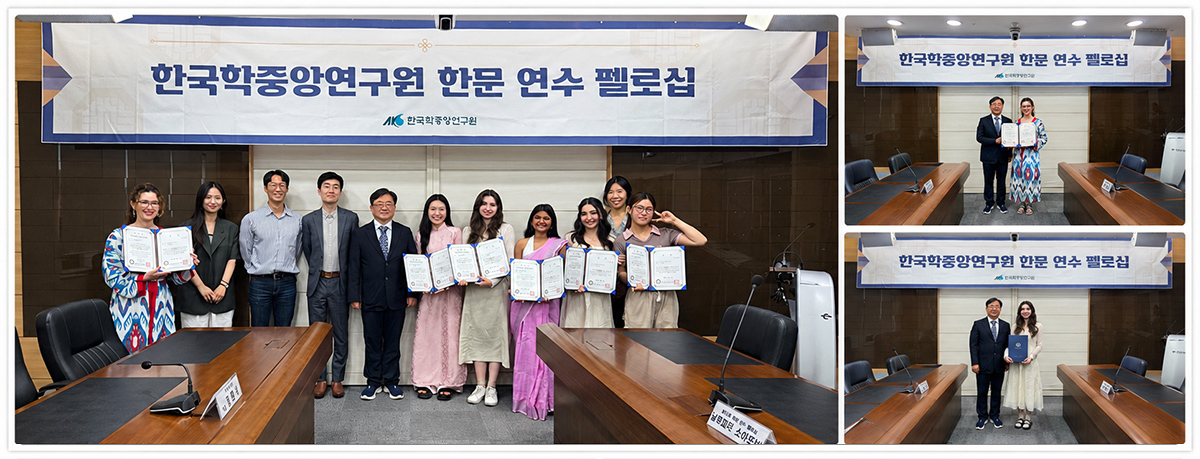
The Division of International Support for Korean Studies under the Center for International Affairs at the Academy of Korean Studies successfully held the graduation ceremony for the “13th Classical Chinese Training Fellowship” on June 18, 2026.
This Classical Chinese Training Fellowship ran for 16 weeks from March 3 to June 18, 2026, with six fellows selected from four countries around the world participating to deepen their understanding of Korean classical studies. The participants explored the philosophical depth of the Analects (Lunyu) and the Historical Record of the Three Kingdoms (Samguk Sagi), solidified their foundations in Classical Chinese through the Book for Enlightening the Young Mind (Gyemongpyeon), and further strengthened their ability to decipher original Korean classical texts.
Notably, driven by their exceptional passion for their studies, all fellows achieved outstanding results on the Chinese character exam, demonstrating their solid foundational skills as scholars of Korean studies and making the program a more meaningful experience.
The six researchers, having learned the value of Korean classics and successfully completed the fellowship program, are expected to serve as a strong bridge for Korean studies research around the world.