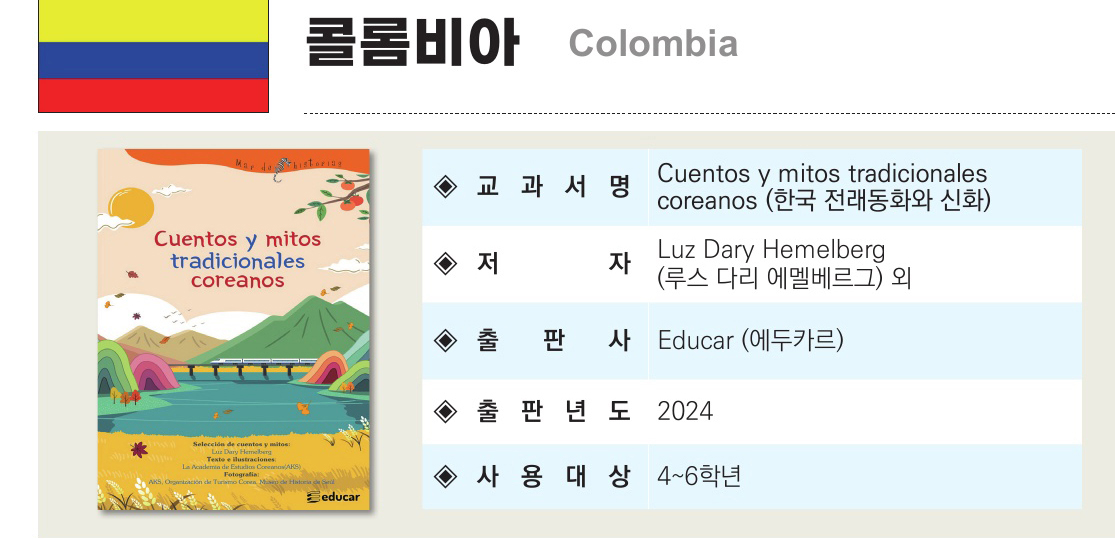
The material to be introduced this time is 《Cuentos y mitos tradicionales coreanos (Traditional Korean Folk Tales and Myths)》, a reading textbook for primary school students in grades 4 to 6. A total of 17 Korean folk tales and founding myths are included in this textbook. This achievement is the result of the 2017 Invitation Program, the 2023 Educational Cooperation Program for the Latin American Region, the textbook improvement projects promoted by the Center for International Affairs (CEFIA), and continuous exchanges with local educational and textbook experts.
- Introduction of Korean Content| Official publication of a primary reading textbook entirely composed of Korean folk tales and myths through Colombia's major textbook publisher Educar.
- The Fruit of Long-term Cooperation| An outcome achieved through continuous textbook improvement activities and consistent exchanges with local educational and textbook experts since 2017.
- Rich Korean Content| Inclusion of a total of 17 folk tales and founding myths, maximizing learning effectiveness by providing connected contextual information within the stories.
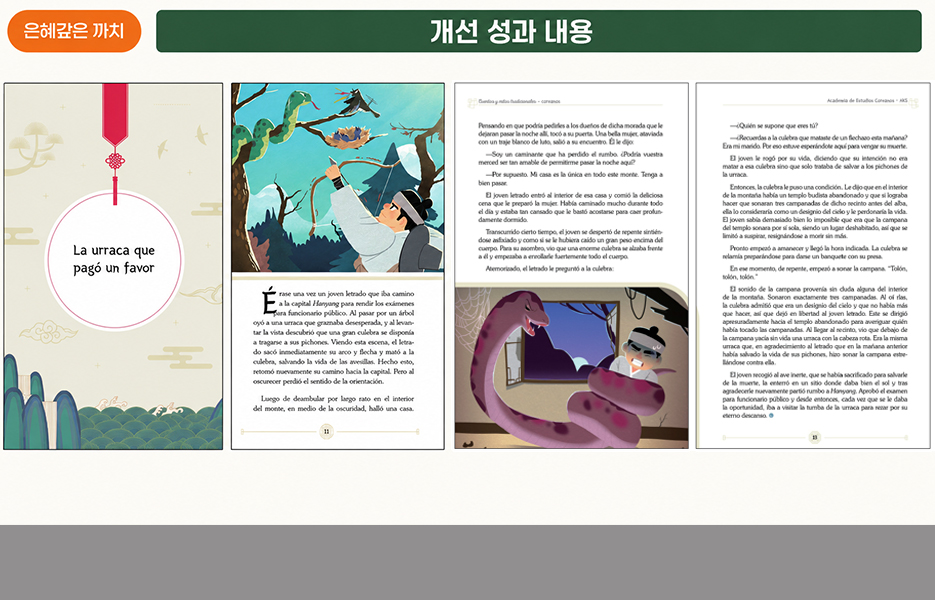
Key Example 1. Korean Traditional Folk Tale 「The Grateful Magpie」
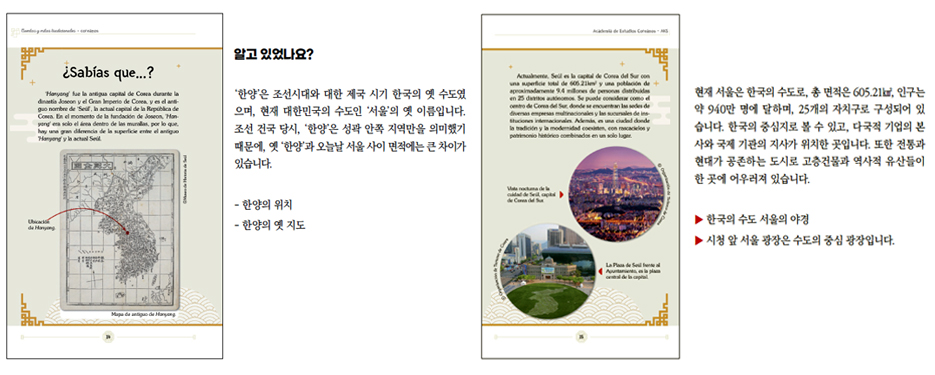
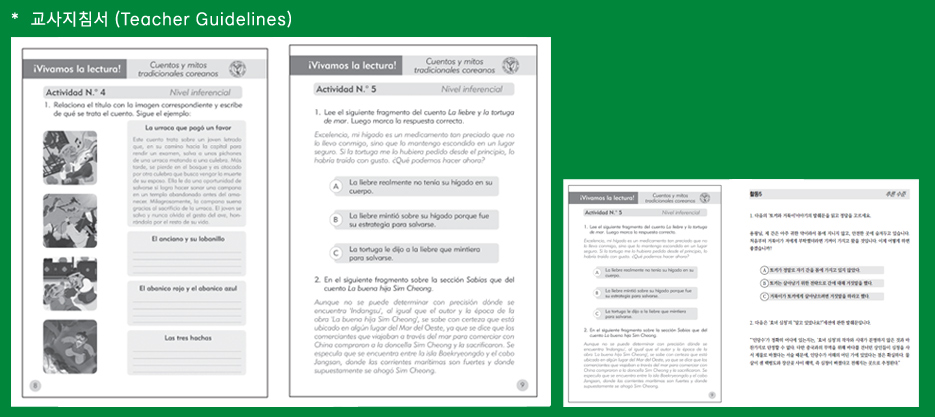
The material is structured to facilitate a multi-dimensional learning experience rather than merely delivering the story content. A prominent feature is the inclusion of a special corner titled “Did You Know This?” to help students understand the place name Hanyang, an old region appearing in the text. This corner utilizes old maps to illustrate the location of Hanyang, naturally guiding students to understand that this area is present-day Seoul, and introduces basic information about Seoul today to enhance learning effectiveness.
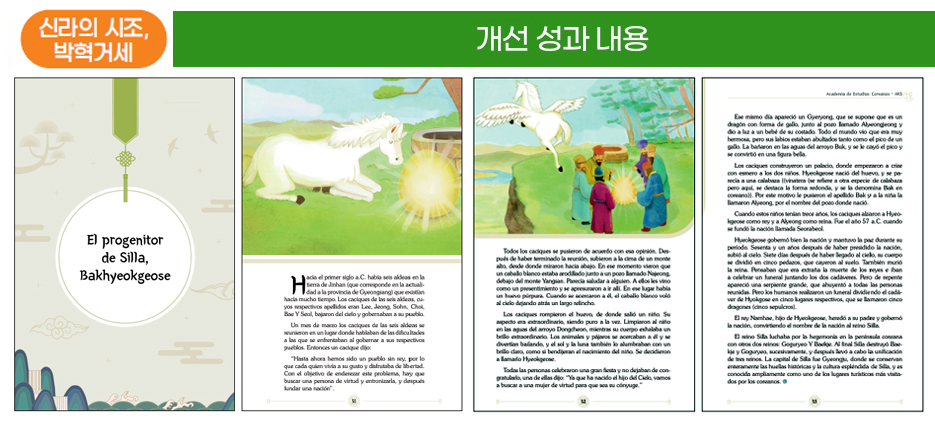
Key Example 2. Korean Founding Myth 「Bak Hyeokgeose, the Founder of Silla」
Along with the text of the Korean founding myth and illustrations that aid comprehension, the textbook introduces the historical regions that serve as the background of the story. Through the “Did You Know This?” corner, it traces the historical origins of places like Jinhan and Silla (Gyeongju), which are where the myths take place, while explaining that these areas correspond to the present-day Gyeongsang Province region of South Korea. By providing practical status information such as the location, area, population, and major cities of Gyeongsang Province today, it helps students comprehend the mythical spaces with a sense of reality.
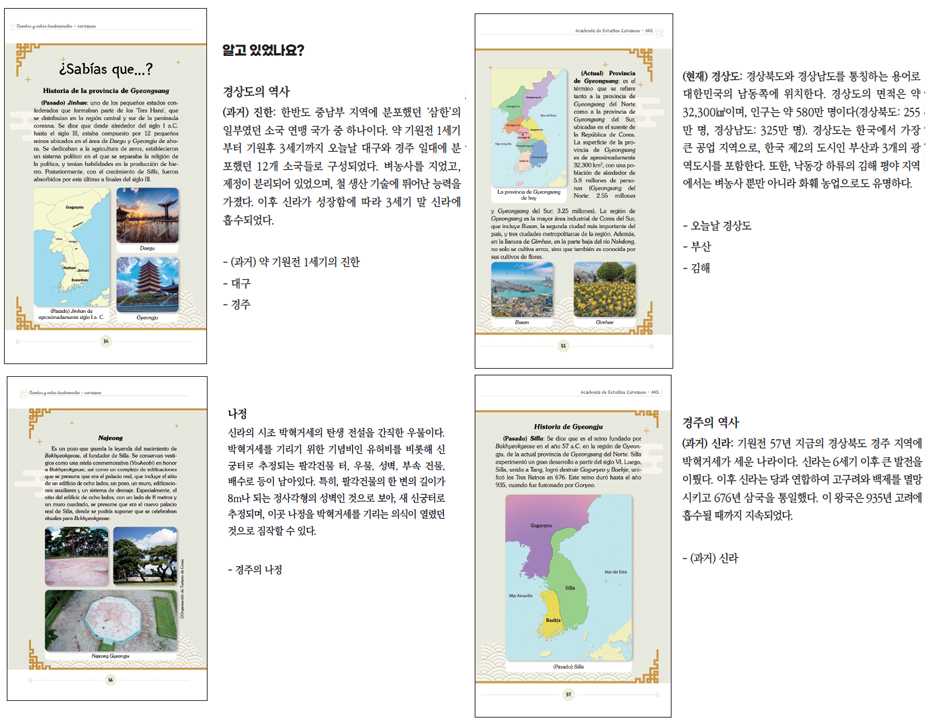
- Learning about Korea as an Alive and Breathing Space| Instead of treating myths and fairy tales merely as static stories stuck in the distant past, students can understand them in connection with the currently advanced state of South Korea.
- Connecting History with the Present| Through various materials such as historial maps, students can examine the historical background and compare it with today's appearance to grasp South Korea's cultural and historical context.
- Enhancing Understanding through Visual Materials| By utilizing a variety of visual aids including illustrations, maps, and photographs, students can easily understand the learning content and foster their interest in Korean history and culture.