The material introduced in this issue is 《Geography (2017)》, a geography textbook used in international secondary education. The textbook includes cases related to South Korea’s smart city development, territorial decentralization, urban regeneration, and resource management. This achievement reflects the long-term textbook improvement efforts promoted by the Division of Understanding Korea Project, as well as continued exchanges with educators and textbook experts.
- Inclusion in an International Geography Textbook| Korea-related urban and industrial cases newly included in Oxford’s IB Diploma Programme geography textbook.
- Cases of Urban and Spatial Transformation| Korean examples such as the development of the Gongju-Yeongi region and the Songdo smart city within IFEZ presented in connection with contemporary urban issues and spatial restructuring.
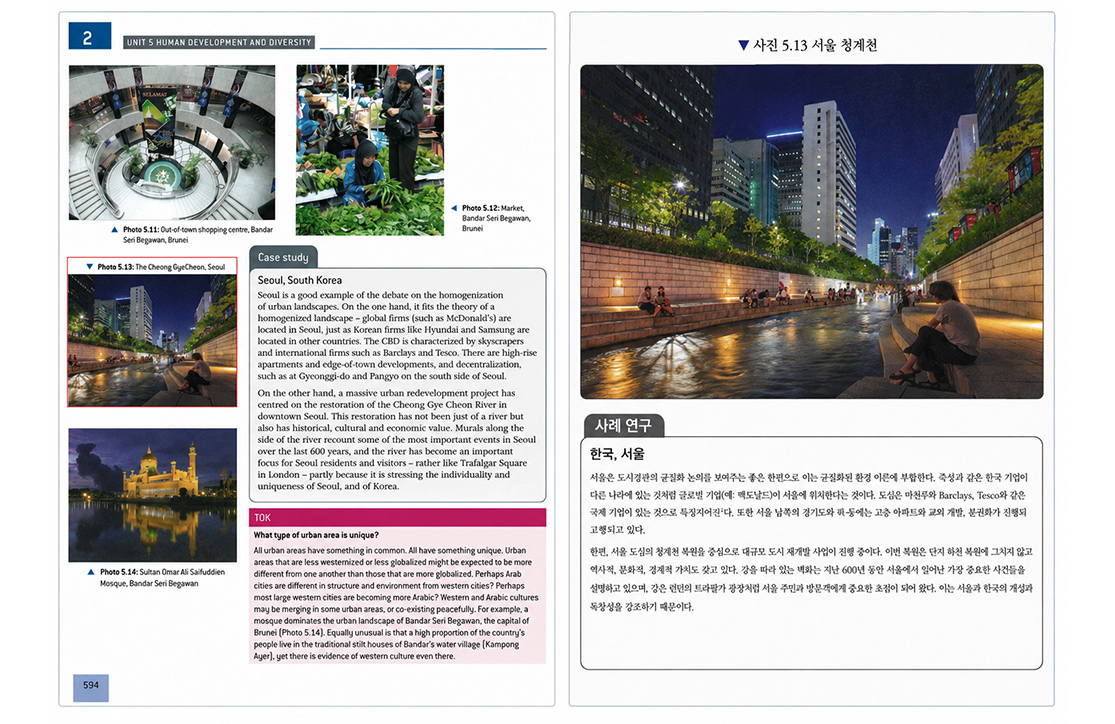
- Resource Management and Urban Identity| Introduction of the POSCO case in relation to Boserup’s theory and Seoul’s Cheonggyecheon restoration as an example of urban landscape transformation.
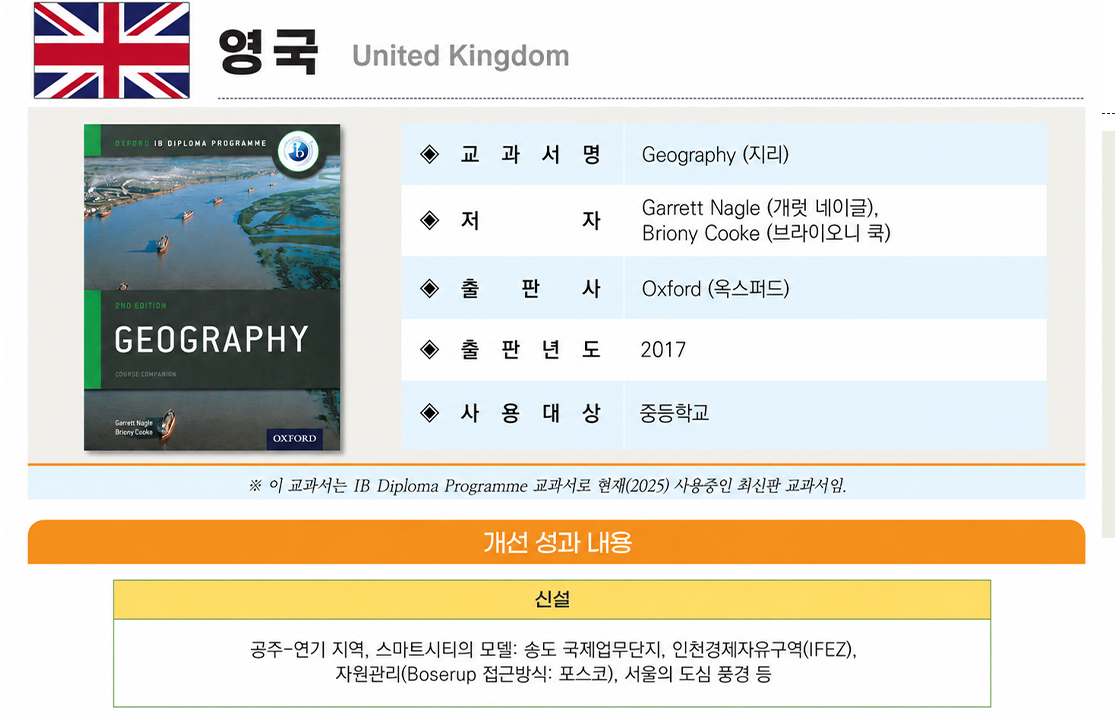
Key Example 1. Planned Urban Development for Balanced National Growth and Security Considerations: The Gongju-Yeongi Region
In the unit on urban environments, the textbook discusses the development plan for the Gongju-Yeongi region in South Korea, now associated with Sejong City, as an example of a national policy intended to address the overconcentration of large cities. Presented alongside Brasília and Canberra, this project is described in relation to economic aims such as easing Seoul’s population concentration and redistributing national wealth, as well as geopolitical security considerations concerning the reduction of vulnerability to military threats from North Korea.
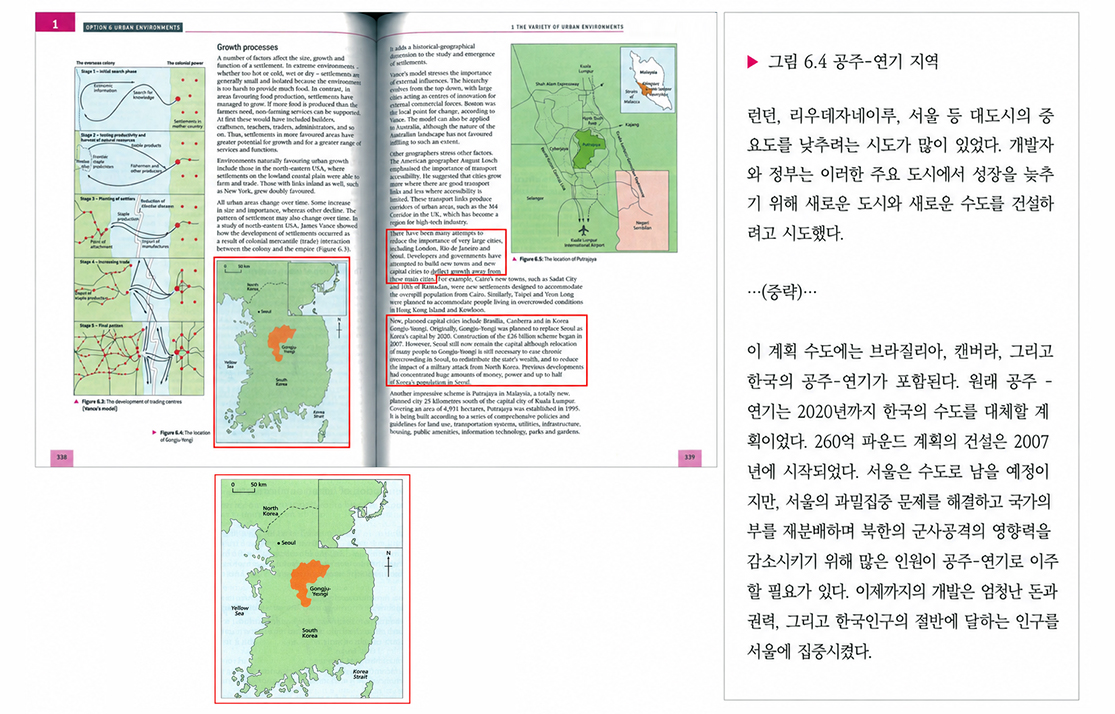
Key Example 2. Songdo International Business District and IFEZ as a Smart City Case
In the unit on building sustainable urban systems for the future, Songdo International Business District (Songdo IBD) is presented as a case study. The textbook explains elements of a sustainable urban system, including sensor-based urban management, video conferencing, health care, education and government services, LEED certification, reduced water use, and decreased energy loss. It also presents not only the advantages of IFEZ, but also limiting factors such as concerns over educational gaps related to expensive foreign school tuition within the free economic zone and the risks associated with North Korea. The activity questions guide students to discuss Songdo’s location, the potential of smart cities, and the value of smart-city development.
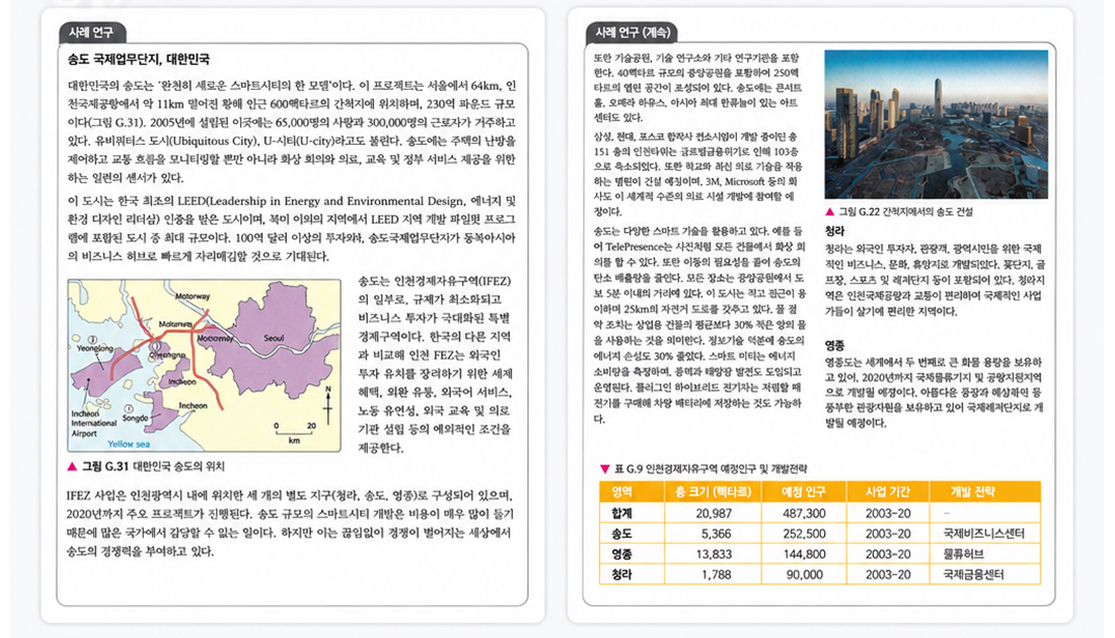
Key Example 3. Explaining Resource Limits through Human Ingenuity: POSCO and Boserup’s Theory
In the resource management unit, the textbook uses the case of the POSCO steelworks in Pohang to explain the theory of economist Ester Boserup, who argued that population growth can stimulate technological development. A photograph of a sign at the POSCO steelworks bearing the slogan "資源은 有限, 創意는 無限(Resources are limited, Creativity is infinite)" is included in the textbook, connecting the learning theme of resource constraints and human ingenuity with a Korean example.
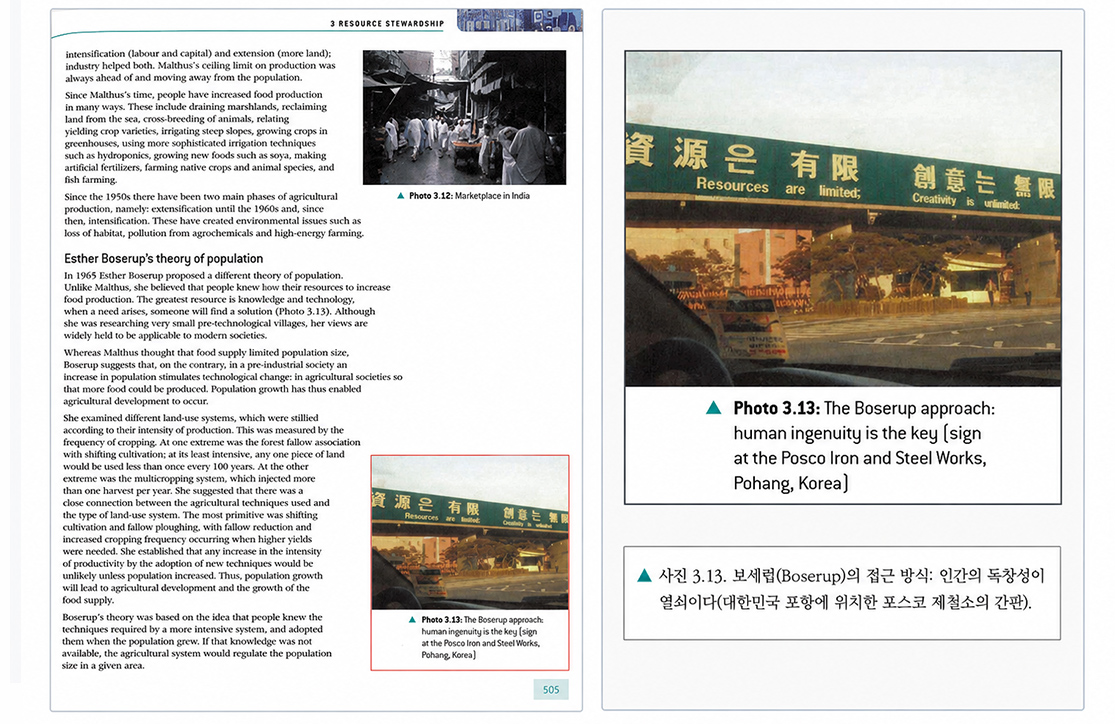
Key Example 4. Cultural Distinctiveness within Urban Homogenization: Seoul and the Cheonggyecheon Restoration
In the unit on changing identities and culture, Seoul is presented as a case in the discussion of urban homogenization, in which global brands and similar urban landscapes spread across world cities. The textbook explains that, while Seoul shows features such as high-rise buildings and the presence of multinational firms, the Cheonggyecheon restoration project in downtown Seoul reveals historical, cultural, and economic value. It also compares the space to London’s Trafalgar Square, describing it as an important urban focal point for Seoul residents and visitors.
- Learning Contemporary Korean Cases| Students can understand South Korea not only through narratives of the past, but also through examples of twenty-first-century urban and spatial transformation, including smart cities, decentralization, and urban regeneration.
- Encouraging Multi-dimensional Academic Discussion| Rather than presenting achievements alone, the material helps students develop a balanced sense of reality and analytical skills by considering risks and inequality issues faced by cities.
- Expanding Understanding of Korea| Learners in international curricula can encounter modern Korea’s urban development, industry, resource management, and cultural identity within the context of geography education.