The Center for International Affairs (CEFIA) at the Academy of Korean Studies (AKS) analyzes Korea-related content in foreign textbooks and continues to engage in various exchanges and to provide materials to ensure that this content is accurate and balanced.
 The case study introduced here is MÉMO BAC HISTOIRE-GÉOGRAPHIE Terminale A, B, C, D 2e édition, a supplementary textbook for high school seniors in Côte d'Ivoire to prepare for the baccalaureate. The material presented below is a summary of the improvements achieved through the 2021 Online Textbook Seminar for Foreign Textbook Experts and the 2024 Invitation Program for Textbook Experts as well as the provision of relevant material for supplementary textbook development.
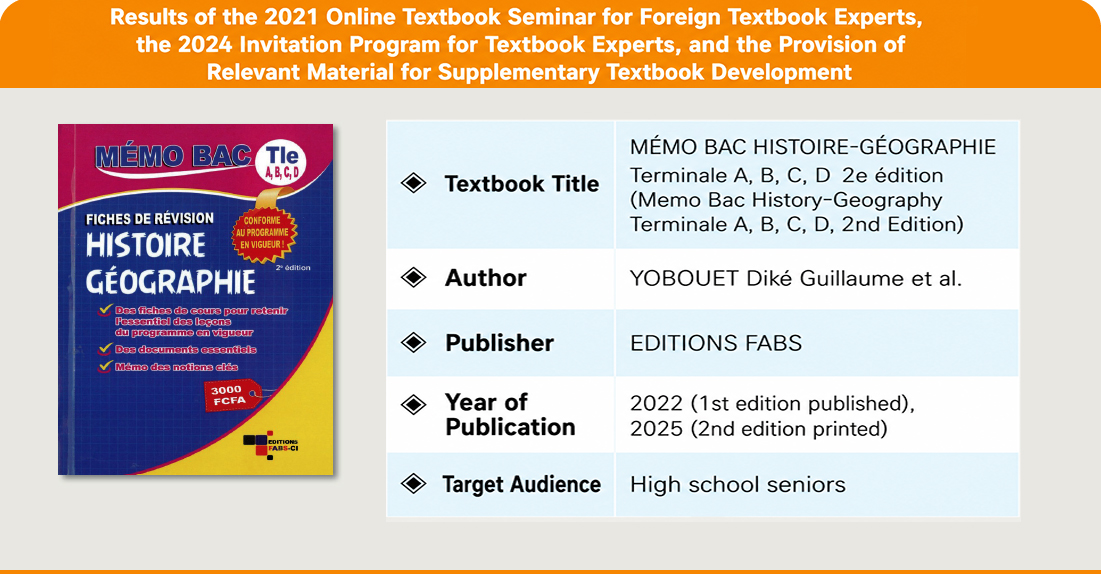 A supplementary textbook for high school seniors in Côte d'Ivoire to prepare for the baccalaureate 『MÉMO BAC HISTOIRE-GÉOGRAPHIE Terminale A,B,C,D 2e édition』
From "An Example of an Emerging Country" to "A Model for Economic Development"
The most notable improvement is the sub-heading related to Korea. The previous expression, "Korea: An Example of an Emerging Country," was revised to "Korea: A Model for Economic Development."
The textbook presents the characteristics and industrial structure of the Korean economy as well as the role of information and communications technology (ICT) and importance of the tertiary industry within it. It also examines the achievements of the Korean economy while pointing out the limitations of the Korean development model that Côte d'Ivoire may reference.
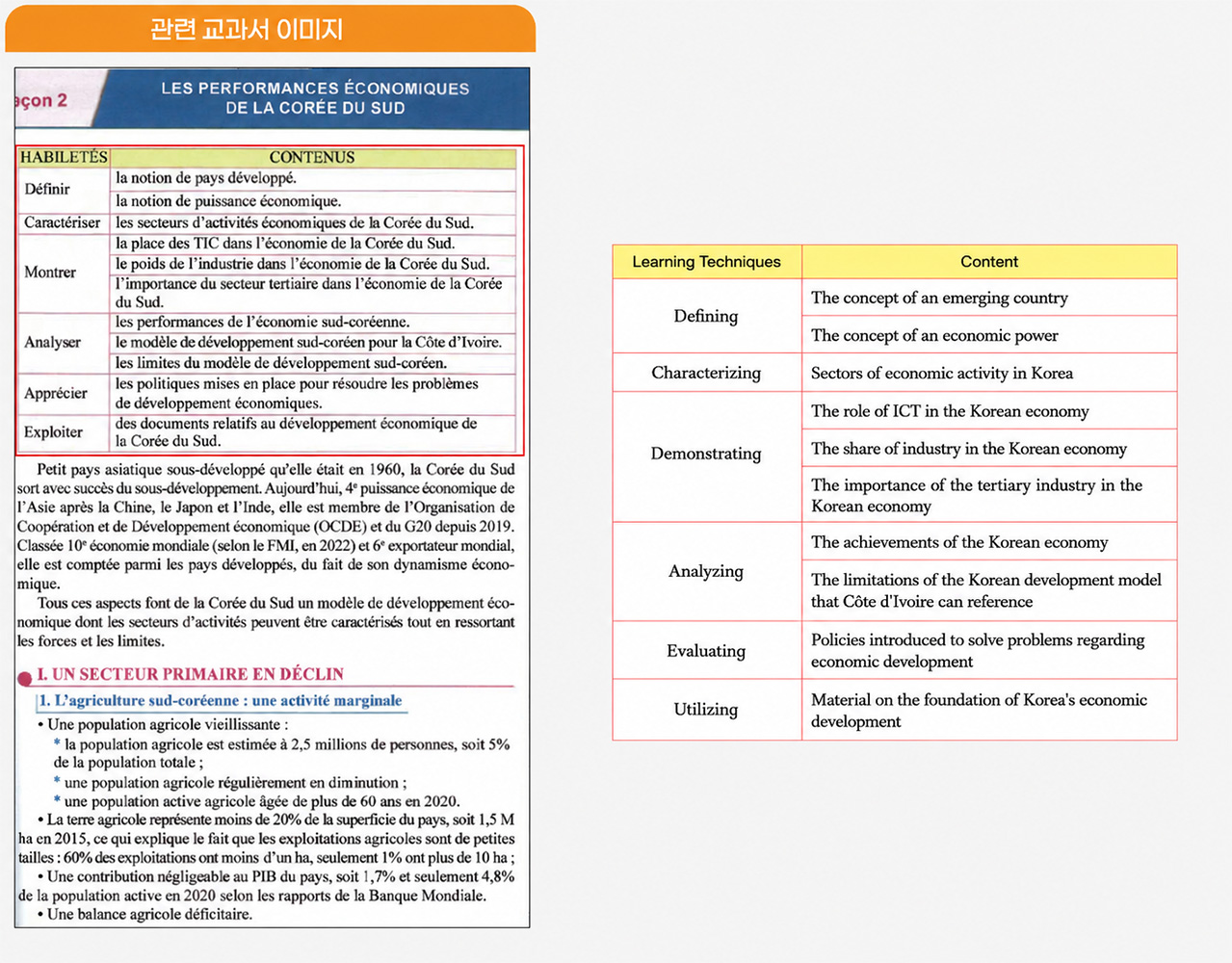 Korea-related content was presented in connection with learning strategies such as defining, characterizing, demonstrating, analyzing, evaluating, and utilizing.
Updated Content Related to Korea
Content on Korea's products and tourism industry was also updated. The "Diverse Products" section now provides explanations of agricultural production volumes and the fisheries industry. The updated "Rapidly Growing Tourism Industry" section introduces Korea's historical and cultural resources as well as tourist attractions.
| Products | Data on the production volumes of rice, vegetables, fruits, and medicinal plants were presented along with content related to South Korea's fisheries industry. |
|---|---|
| Tourism Industry | Jeju Island, the royal palaces in Seoul, the city of Gyeongju, Haeinsa Temple, traditional villages, Korean cuisine (Hansik), Taekwondo, Hangeul (the Korean alphabet), and various festivals were introduced as South Korea's major tourist attractions. |
| Development Factors | The education system, workforce development, strengthening the capacity of rural communities, national savings, industrial creation and diversification, the service sector, and the utilization of ICT were identified as the key factors behind South Korea's development. |
South Korea's Development Experience as a Model for Côte d'Ivoire
"The Republic of Korea as a Development Model for Côte d'Ivoire" section was newly added to the textbook. This section summarizes why South Korea is evaluated as an exemplary development model from multiple perspectives including its education, workforce development, rural communities, industrial diversification, the service sector, and ICT.
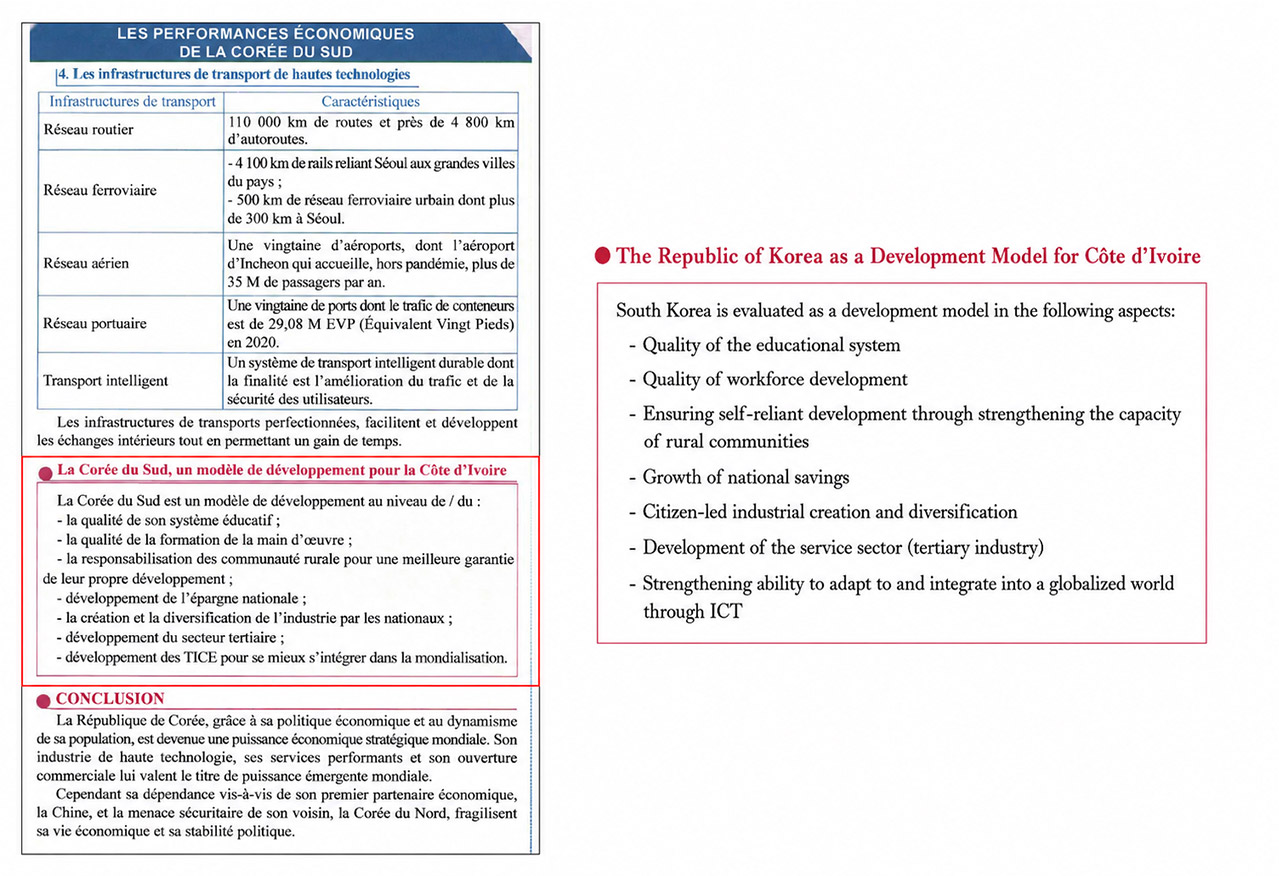 The textbook presents the Republic of Korea as a development model that Côte d'Ivoire can refer to and summarizes major factors of its development category.)
Significance
This case serves as an excellent example where Korea-related content within a foreign textbook expanded into a more specific and structured learning theme.
By addressing the products, tourism industry, and core development factors of South Korea in addition to its economic development experience, the textbook now provides local students with a multidimensional understanding of Korea including its economy, industry, and culture.