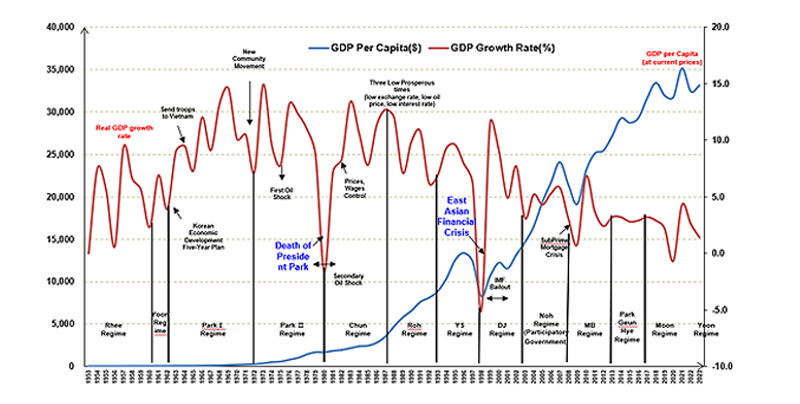
Since the 1960s, the Republic of Korea (hereafter ‘Korea’) has achieved remarkable economic growth, unprecedented on a global scale. Looking at macroeconomic indicators over the past 60 years, there were certainly major external crises and periods of stagnation, such as the first and second oil shocks, the East Asian financial crisis in the late 1990s (IMF bailout), and the 2008 subprime mortgage crisis.
However, the Korean economy has overcome these crises with strong resilience. GDP per capita has consistently shown an upward trajectory. As a result of a dedicated focus on industrialization, beginning with the Five-Year Economic Development Plans, the country successfully leaped from a developing nation to a developed one, achieving sustainable national economic development based on GDP per capita.
Figure 1: Sustainable Economic Growth in Korea
Source: Jung, S.-H., 2025, ‘A Critical Review of Special Zone Policies in the Republic of Korea: Towards Spatial and Institutional Rearrangement’, 7th Global Conference on Economic Geography, 4-8 June 2025, Clark University, Worcester, Massachusetts, USA / Clusters, enclaves, zones and corridors: geographies of extensive economic realms 1, 7th June, 2025.
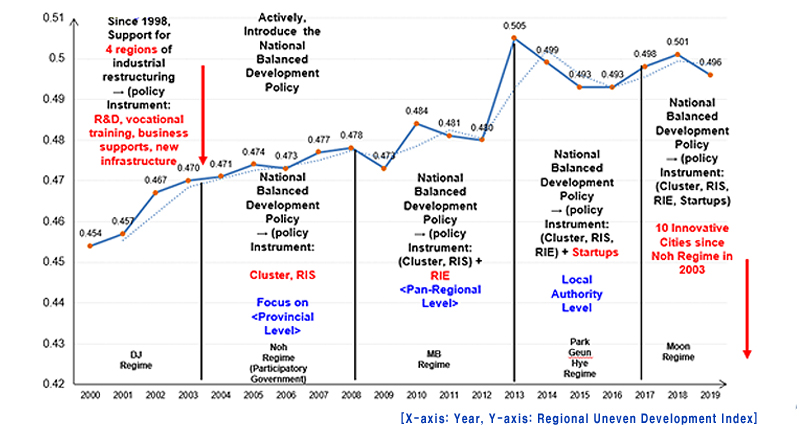
Starting with the full-scale introduction of the balanced national development policy by the Participatory Government (Roh Moo-hyun administration) in the 2000s, successive governments - including the Lee Myung-bak, Park Geun-hye, Moon Jae-in, Yoon Suk-yeol, and Lee Jae-myung administrations - have made massive efforts to resolve regional inequality. Various policy instruments were mobilised, such as cluster formation, the establishment of Regional Innovation Systems and ecosystems, the construction of innovation cities, and the fostering of start-ups.
Despite these efforts, the concentration of resources in the Seoul metropolitan area and spatial inequality indices have scarcely improved. Instead, regional uneven development remains South Korea's greatest structural challenge, directly leading to regional demographic and socio-economic crises.
Figure 2: Transition of Regional Uneven Development and National Balanced Development Policies
Source: Jung, S.-H., 2025, ‘A Critical Review of Special Zone Policies in the Republic of Korea: Towards Spatial and Institutional Rearrangement’, 7th Global Conference on Economic Geography, 4-8 June 2025, Clark University, Worcester, Massachusetts, USA / Clusters, enclaves, zones and corridors: geographies of extensive economic realms 1, 7th June, 2025.
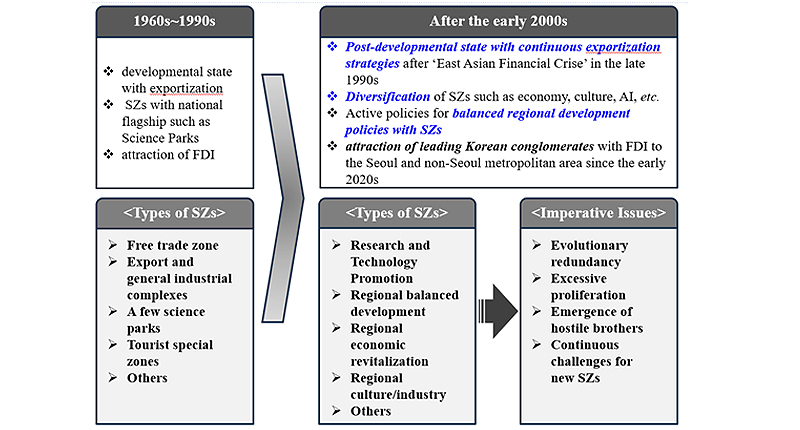
To maintain continuous economic growth while tackling this worsening regional inequality, Korea has implemented a massive array of 'Special Zone' policies, establishing over 1,000 zones since the 1960s. This represents a highly unique and dynamic trajectory of spatial development globally. The evolution of special zone policies can be broadly divided into two periods.
From the 1960s to the 1990s, under an 'export-led developmental state' system, the focus was on free trade zones and export or general industrial complexes aimed at attracting foreign direct investment and creating national flagship research parks.
Conversely, since the early 2000s, there has been a transition to a 'post-developmental state' system, vitalizing balanced regional development policies mediated by special zones. The types of special zones have diversified to include industry, science and technology, regional economy, culture, and AI, while competition to attract large corporations and investments has expanded nationwide.
However, this process has also spawned side effects that urgently need addressing, such as the evolutionary overlap of similar zones, excessive proliferation and overuse, and the emergence of 'hostile brothers' signifying cut-throat competition between local governments.
In conclusion, the tasks facing economic geography in Korea can be summarized into three main pillars: 'securing the sustainability of compressed growth and development at the national level', 'alleviating structural uneven regional development', and 'improving efficiency through the reform of special zone policies'.
Accordingly, economic geographers must recognize that current institutions related to the overall trajectory of economic and regional development are failing to meet the demands of real world changes. Moving forward, it is necessary to focus academic and practical capabilities on establishing a ‘Korean New Regional Development’ model. This model should focus not only on reforming the special zone system itself but also on the unique industrial characteristics, innovation capacities, and institutions inherent to each region.
Figure 3: Conceptual Framework of Special Zone Policies in Korea
Source: Jung, S.-H., 2025, ‘A Critical Review of Special Zone Policies in the Republic of Korea: Towards Spatial and Institutional Rearrangement’, 7th Global Conference on Economic Geography, 4-8 June 2025, Clark University, Worcester, Massachusetts, USA / Clusters, enclaves, zones and corridors: geographies of extensive economic realms 1, 7th June, 2025.