When I traveled to South Korea in the spring of 2019 as a participant in the Understanding Korea Project, I was working on an introductory world history textbook for use mainly in college and university classrooms in the United States. At that time Laura J. Mitchell, one of the history educators in our group of visitors the AKS sponsored, was my textbook coauthor. Laura subsequently had to drop out of our project, and she is now the editor of the award-winning Journal of World History. In 2020 Urmi Engineer Willoughby, a historian at Pitzer College in California, joined me in completing the two-volume textbook, titled Panorama, A World History. It was published by Bloomsbury Academic this past February.
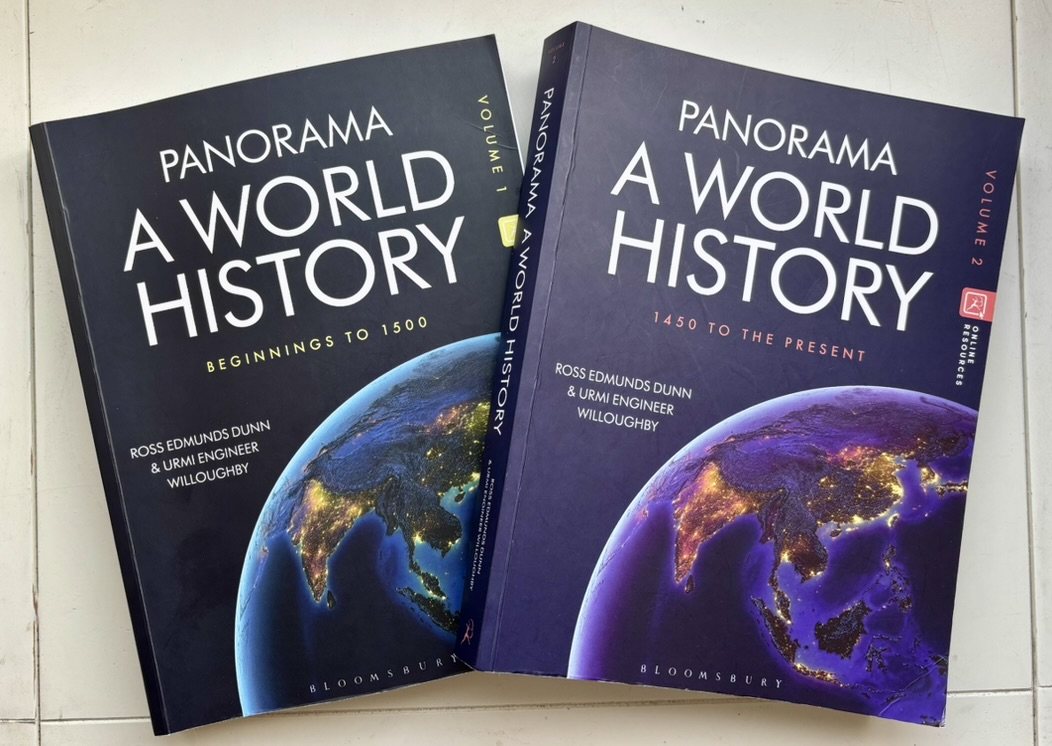
Description: Bloomsbury Academic published the two volumes of Panorama: A World History by Ross Edmunds Dunn and Urmi Engineer Willoughby in February 2026.
Panorama has dozens of colorful images and maps. I asked Dahee Kim, our AKS host, if she might provide some images of Korea for the books. That led to several productive exchanges between her and me, resulting in our choosing two images that appear in Panorama. One is a dramatic photo of the Silla royal tombs in Gyeongju, the other a poignant image of a refugee family fleeing the Korean War.
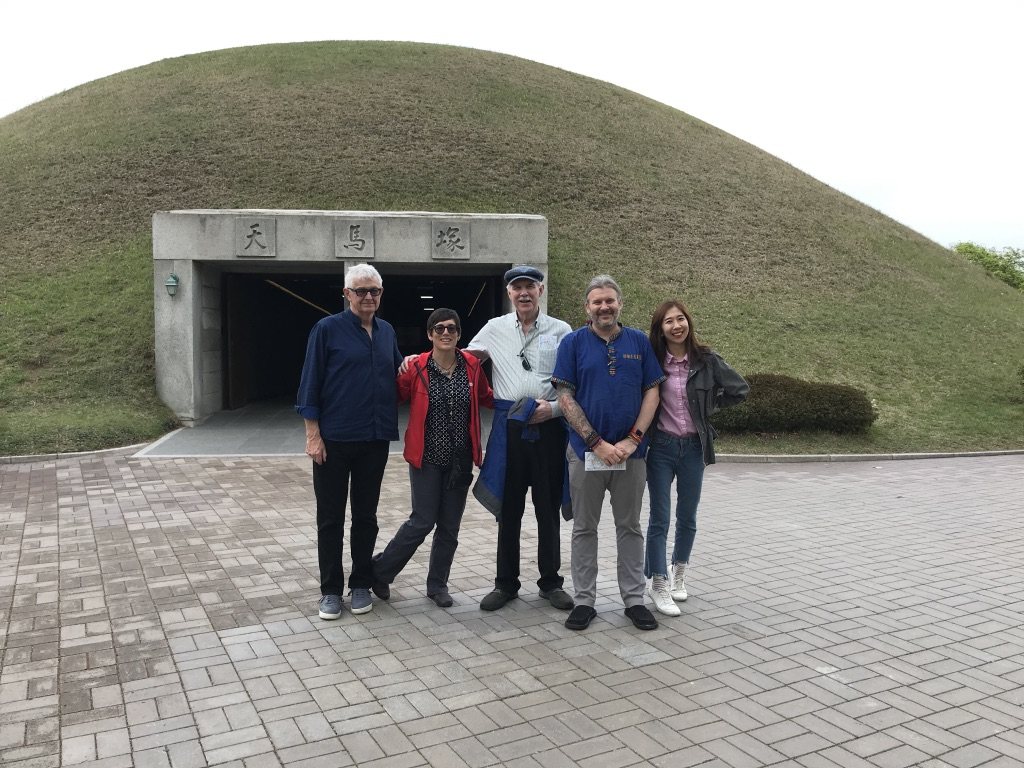
Description: In April 2019 Dahee Kim of the Academy of Korean Studies led four American educators on a tour of the Silla Royal Tombs. From left: Ross Dunn, Laura Mitchell, Roger Beck, Bram Hubbell, Dahee Kim.
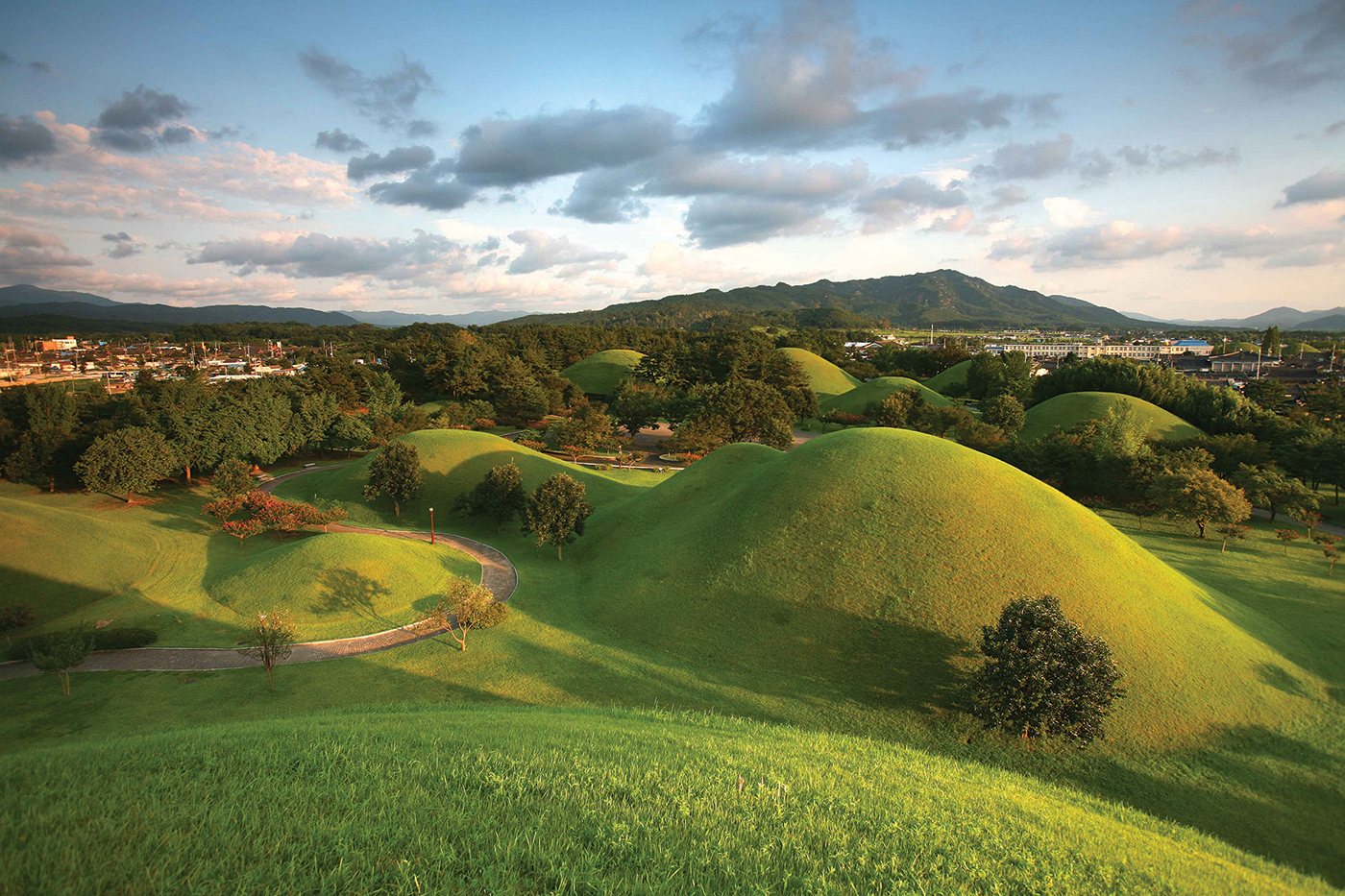
Description: Gyeongiu, capital of the Silla kingdom, is the site of several tumuli, or burial mounds, containing the remains of Silla rulers. This image appears in Panorama, volume 1, courtesy of the Academy of Korean Studies.
Panorama takes a distinctive approach to writing a world history survey text. Most introductory books have been organized in either of two ways. One is to arrange chapters to address the histories of civilizations and large regions one after another, usually including some discussion of interactions among them. The other is to build chapters around subject matter themes within specified time periods, exploring political developments in one chapter, economic topics in the next, cultural history in a third, and so on. By contrast, Panorama’s chapters focus on successive eras of world history. Each chapter is constructed around important historical turning points on either hemispheric or global scales. The narrative moves along a unilinear global timeline, rather than repeating periods several times from different regional or thematic perspectives. This more holistic approach encourages comparison of developments in different regions during particular periods, emphasizes the interconnections among societies, and helps readers think about the “big pictures” of world history on interregional and global scales.
A two-volume introductory text must of course address regions, states, empires, and ethnic populations. But because it spans the human past from the Paleolithic era to the near present, Panorama cannot probe the history of any society in great detail. Nevertheless, my participation in the Understanding Korea Project led us to extend and strengthen the necessarily limited sections dedicated to the peninsula’s history.
The AKS meetings also encouraged me to more effectively situate Korea in the larger scale history of Afroeurasia (the giant landmass of Eurasia and African together) in premodern times. Here’s an example of how Panorama does that. In volume one we introduce the idea that as early as the first millennium BCE, the several large waterways that stretch across Afroeurasia, what we call in Panorama the “chain of seas,” became the scene of growing networks of long-distance commerce. Maritime merchant groups, which sometimes formed large organizations, relayed goods along this chain from one region of Afroeurasia to another We count eleven seas in the network, which by way of straits and a few overland passages, ultimately connected the East Sea with the Baltic Sea in northern Europe. By the first century BCE, for example, precious spices produced in Southeast Asia were reaching markets in the Roman empire’s European provinces.
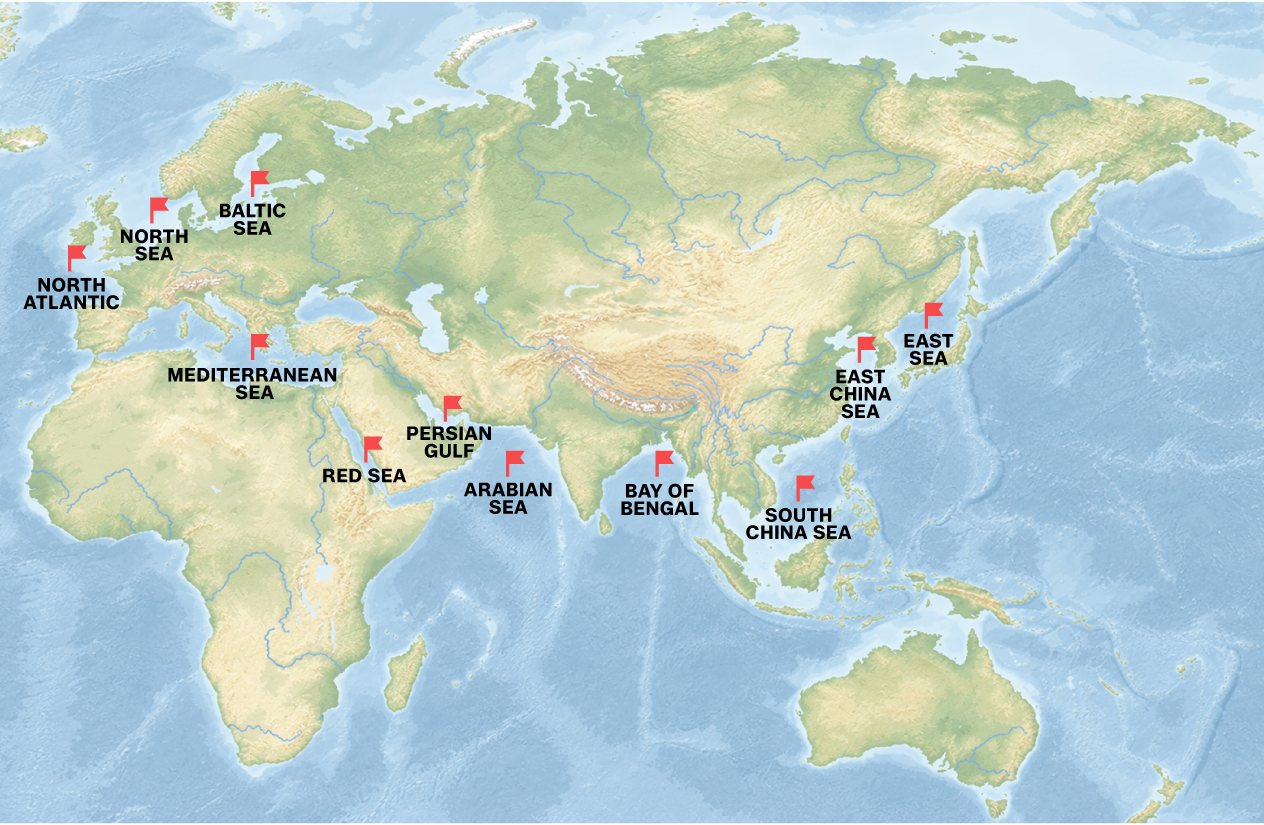
Description: Map, Afroeurasia’s Chain of Seas.
Early in the first millennium CE, the East Sea and the East China Sea, the two eastern most waterways in the chain, emerged as a busy zone of seaborne and overland trade, migration, and cultural exchange. These two seas connected China, Korea, and Japan, not only with one another but eventually with Southeast Asia and lands farther west along the chain. By way of the East and East China sea routes, rice farming, iron metallurgy, sericulture, textile technology, writing, central governing techniques, and Buddhism spread from China to Korea and from there across the 125 miles of the Korea Strait to Japan. During the era of the Silla kingdom (668-935 CE), the first Indigenous state to rule a united Korea, trade and travel flourished between Korea, China, and Japan. According to a ninth century Arabic chronicle, Muslim merchants who visited Chinese ports in the later first millennium CE acquired Korean products, including swords, brocade, porcelain, and other goods, then transported them to Southeast Asia, India, and perhaps the lands rimming the Arabian Sea. In subsequent centuries, of course, Korea’s links to the rest of Afroeurasia by way of the chain of seas only became stronger.
In the past few decades world history education has bloomed in Korea, partly under the influence of American educational models imported in the post-World War II period. The idea I have addressed here of placing the Korean past in transregional and global contexts will be perfectly familiar to a growing body of South Korean world historians. In 2021, for example, Sogang University established the Critical Global Studies program under the founding leadership of Prof. Jie-Hyun Lim to advance transnational, transregional, and transdisciplinary education. The program’s introduction states: “Visions of the humanities must transcend artificial boundary formations regarding humans—such as nation, class, gender, race, culture, civilization, and religion—and ultimately be open to humankind.” (https://cgsen.sogang.ac.kr/cgsen/whatis.html). Recently, Korean scholars demonstrated their commitment to global-scale education by hosting in Inchon the annual meeting of the World History Association, an international organization founded in the United States in the 1980s. Although I was not able to attend the conference, which would have been my fourth trip to South Korea, I deeply appreciate the Academy’s participation in the event’s planning and success.