Developing educational content about the Republic of Korea means building a cultural bridge that is accessible, respectful, and meaningful for Costa Rican students. When we began the ¡Hola, Corea! project, we assumed that one of the greatest challenges would lie in deciding which aspects of the Republic of Korea we should include. However, as the project progressed, I discovered that the central question was a different one: how do you present a cultural, historical, and social reality this vast to Costa Rican students of different ages without oversimplifying it or reducing it to a mere list of facts?
Currently, together with three other colleagues from Eduvisión's Editorial Production Area, I coordinate the development of a complementary educational collection about the Republic of Korea, aimed at Costa Rican students at different levels. The purpose of the project is to bring them closer to Korean history, culture, society, and contemporary reality through content that is rigorous, understandable, and appropriate to each educational stage. The work combines research, content selection and editing, pedagogical adaptation, language review, copy-editing, visual design, and validation by the Embassy of the Republic of Korea in Costa Rica and the Academy of Korean Studies (AKS), all aimed at improving the accuracy and quality of the content. This is not simply a matter of gathering data; rather, we must turn each topic into a learning experience that is understandable and meaningful, built with the support of a team spanning different specialties.
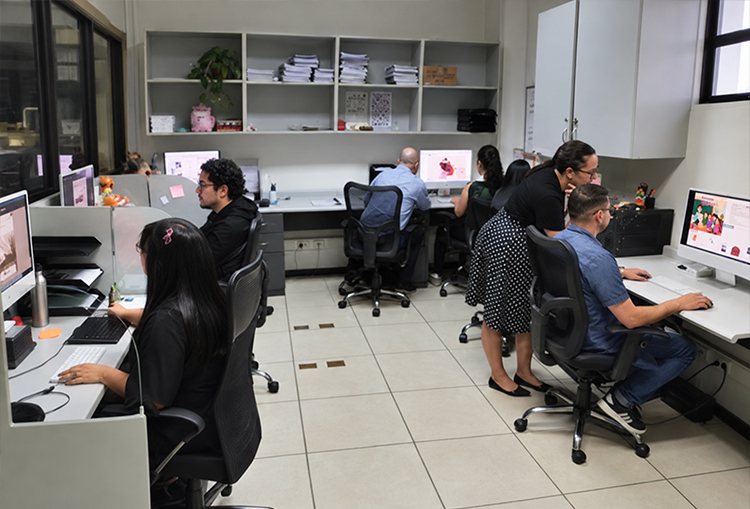
Description: Production site of the supplementary material 『Hello, Korea!』 (¡Hola, Corea!)
The Republic of Korea represents an enormous thematic universe. Every piece of content calls for constant decisions: what information to include, at what level of depth, which terms to use, what references the student needs, and which associations might lead to a biased understanding. Added to this is the fact that our target audience usually approaches the Republic of Korea through very specific touchstones, such as K-pop, cuisine, television series, or technology. For this reason, part of the challenge lies in broadening that perspective with the historical and social foundations essential to understanding the processes that allowed the country to rebuild itself and become an economic and technological power.
For example, when we faced the challenge of explaining Seoul's urban growth, presenting data on population density, transportation, or technological advances was not enough on its own. We found that the real pedagogical value lay in connecting that transformation to a context closer to the student: San José. In this way, comparing the two cities would make it possible to identify similarities, contrasts, and shared challenges, without turning either city into an absolute point of reference for the other. Something similar happened when explaining waste management: it was necessary to translate a complex system into a visual proposal that was clear and accessible without losing precision. These experiences have confirmed for me that adapting content does not mean reducing it, but finding the most effective way to make it understandable for a specific reader.
This challenge takes on an added dimension when we consider that there is no single reader for these materials. We are addressing students between 7 and 17 years old, whose prior knowledge, interests, and levels of comprehension are very different. For this reason, even when the same topic appears at several levels, it is not enough to simply repeat or shorten the information: the vocabulary must be adapted, the most relevant data selected, and the resources that facilitate learning at each stage defined. Hangeul illustrates this well. We do not merely want students to recognize that the Korean writing system is different from Spanish; we want them to progressively understand its logic and the relationship between some of its consonants and the way we produce the corresponding sounds. For the first cycle, this required relying on concrete explanations, images, and simple comparisons; for the second cycle, it was possible to delve deeper into its history, structure, and cultural meaning.
Being part of the coordinating team for this process has required me to examine every page from multiple perspectives. It is not enough to verify the accuracy of the information; it is also necessary to assess whether the language matches the reader's age, whether the activities support comprehension, whether the images add meaning, and whether each piece of content remains consistent with the collection's overall purpose.
In this exercise, one of the most complex tasks has been finding the balance between rigor and clarity. At times, an explanation may be conceptually correct but turn out to be too abstract for the level it is intended for. At other times, an appealing visual proposal can simplify the content so much that it ends up losing part of its meaning. Part of my work, then, has been identifying those points of balance and constantly asking myself what the student truly needs in order to understand.
The editorial process is enriched precisely because each team member views the material from a different perspective. A comment on design may reveal that an explanation needs to be simplified, and a language review can uncover an ambiguity that had gone unnoticed; a discussion about an activity can even lead us to rethink how we present a piece of content. This dynamic has confirmed for me that coordinating also means listening, weighing different viewpoints, and being willing to revisit decisions that seemed already settled.
This process has made me understand that educational editing is also a form of cultural mediation: the words we choose, the images we incorporate, and the comparisons we propose all construct a particular way of looking at the Republic of Korea. The ¡Hola, Corea! series has been a considerable professional challenge, but also a learning opportunity. Working on it allowed me to understand more deeply how a society marked by difficult historical events managed to rebuild and transform itself through processes in which education, collective work, innovation, and the preservation of its identity proved decisive. Perhaps that is one of the greatest lessons this experience leaves me with: bringing a culture into the classroom does not mean simply teaching about another country, but offering students new ways to understand the world and to view their own reality from different perspectives as well.
Finally, I would like to thank the Embassy of the Republic of Korea in Costa Rica for giving us the opportunity to be part of this project, and Editorial Eduvisión for making possible this bridge that brings two cultures closer together and fosters their encounter through education. I would also like to extend my gratitude to the entire Editorial Production team, whose knowledge, experience, and contributions enriched every stage of the process and are essential for developing quality educational materials, in this case, materials designed to bring the Republic of Korea closer to Costa Rican classrooms.