"What happens when a culture not your own feels like coming home?"
My introduction to Korea did not begin with a textbook or a lesson in school. It started with a song. One afternoon, I came across a music video online. I didn't understand the lyrics, but something about the melody, the voices, and the emotion behind the performance pulled me in. It felt honest. Warm. Familiar, in a way I couldn't quite explain. That was the beginning of a connection that would quietly grow into something deeply personal.
As I listened to more music, I started to feel more curious. What began as a simple playlist soon led me deeper into Korean culture. I began watching Korean dramas, expecting nothing more than entertainment. But I was surprised by what I found. The stories felt real. The characters were flawed and human. The emotions were raw but quiet. These dramas explored themes I already knew-family, love, ambition, loss but showed them in ways that felt gentle and close. It was the kind of storytelling that made me feel seen, even if the language was different.
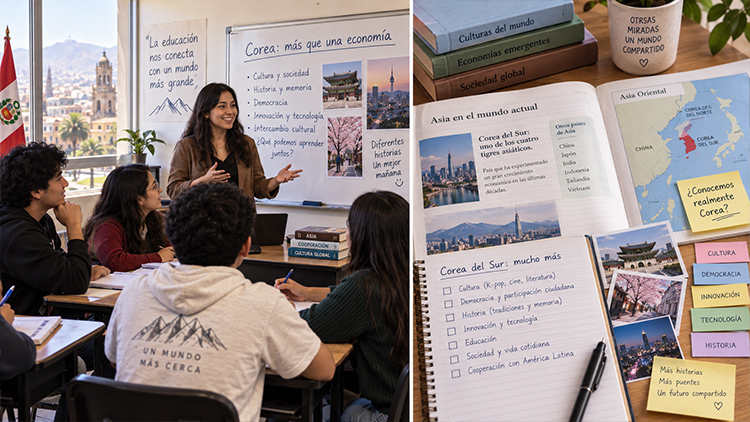
Broadening Understanding of Korea in Peruvian Educational Settings | Image: OpenAI Generative AI
Over time, this connection started to show up in small parts of my life. I began looking for Korean food in local stores, not because it was trendy, but because I was curious about what those meals meant to the people who made and shared them. I began trying to cook simple dishes at home, and even when they didn't turn out quite right, they brought a sense of comfort and belonging. In this way, Korea had subtly made its way into my daily routines, despite the distance and difference.
It was only after this unfolding journey that I began to realize something important: the Korea I had come to love was very different from the one I had learned about in school.
In most international textbooks and websites, Korea is introduced through facts. Students learn about its fast economic rise, its role in global technology, and its success in education. The information is often impressive and detailed, but it focuses mostly on progress, numbers, and achievements. It shows Korea as a powerful and disciplined country. But what it often leaves out are the softer details, the human side.
The Korea I discovered outside the classroom was full of small, meaningful moments. It was present in the way a mother quietly packs lunch for her child, in the way two friends walk home in silence after an argument, in the careful passing of a bowl of soup across the dinner table. It was not about success, but about feeling. About connection. About the unspoken language of care, sacrifice, and closeness.
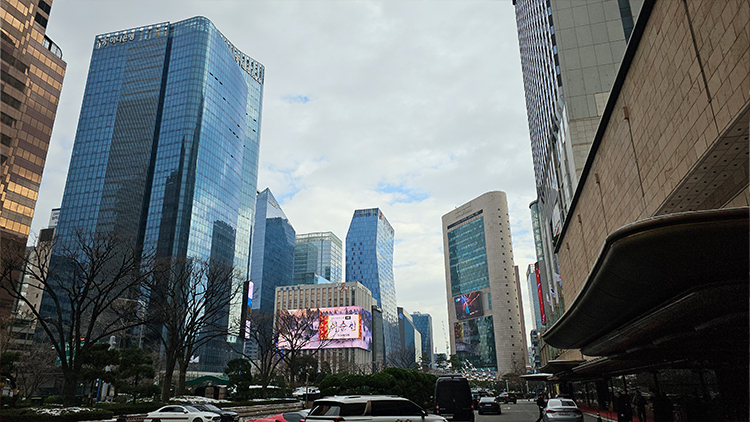
Seoul Cityscape ⓒ DtSeoul / Wikimedia Commons, CC0 1.0
There is a clear difference between the Korea taught in instruction materials and the Korea felt through everyday culture. The first is structured and sharp, shaped to impress. The second is emotional and quiet, shaped to connect. Both are real, but only one helped me feel like I belonged to something, even if I had never been there.
This made me realize something more. Maybe the way we present other cultures in textbooks is not always enough. When we focus only on milestones and national achievements, we forget to include the ordinary lives behind them. We forget to ask how people live, how they express love, how they carry grief, and how they find joy in simple things. And sometimes, those quiet things are what truly stay with us.
Korea became a part of my life not because I studied it, but because I felt it. I did not fall in love with it through facts, but through feeling. Through stories, music, and meals shared through a screen. Through characters who cried the way I had cried. Through songs that comforted me on days I didn't have words for how I felt.
That version of Korea may not always appear in our lessons, but it is just as real. It is present in the quiet gestures, the pauses between words, the tears that are quickly wiped away before anyone notices. It lives in the silences as much as in the celebrations. It is the Korea that many people might never read about in a textbook, yet it is the one that stays with you, that whispers instead of shouts.
This realization made me think more deeply about how we teach and share cultures, especially on a global scale. Often, we introduce nations through their strength, through the things that make them stand out on a map or in economic reports. We are taught to admire skyscrapers, advancements in science, and records of rapid development. These are important, of course. They show the progress a country has made, the resilience it carries, and the future it aims to build. But if that is all we focus on, we risk missing something essential.
There is a quiet power in the everyday, and perhaps this is where Korea has the greatest opportunity to reshape its global image. Not by letting go of what it is already known for, but by embracing what has quietly existed beneath it all along. Korea does not need to choose between innovation and intimacy or between progress and presence. It can hold both, and in doing so, it can share a fuller story one that reaches not just the mind but also the heart.
This story could start with how Korea is introduced not only to students but also to strangers, dreamers, and people like me who found something unspoken in a language we did not yet know. I want Korea to be seen not as a finished product but as a living, breathing culture one where textbooks go beyond timelines and policies to create space for real human voices. In that future, history lessons would not just recount battles and treaties, but would pause to ask what was lost, what was held onto, and what endured in the hearts of ordinary people. Language classes would not only teach grammar and vocabulary, but also the way a single phrase can carry layers of care, how honorifics hold quiet respect, and how the rhythm of speech can echo the values of a culture shaped by both resilience and grace.
In that future, students around the world might still learn about Korea's remarkable rise, but they would also listen to ballads that ache quietly, to drama scenes where nothing happens and yet everything does. They would talk not only about success, but about sacrifice. Not only about brilliance, but about belonging. They would begin to see Korea not just as a country to study, but as a presence to feel. And in that process, Korea becomes not just impressive, but unforgettable.
This vision must extend beyond education and live in cultural exchange, in art, in food, and in shared stories and quiet moments. It must be present in the global spaces where Korea already exists, not merely to entertain but to foster genuine connection. Korea's soft power is already strong, yet its true strength may come from what it chooses to share next-not just its talent but its tenderness, not only what it has built but also what it has carried: the sorrow, the resilience, and the quiet acts of care that rarely make headlines.
Perhaps the next chapter of Korea's global story lies in this quiet offering. In opening the door not only to admiration but to understanding. In allowing the world to see the pauses between dialogue, the tear held back more than the one shed, the way affection is folded into a packed lunch or a late-night text that simply says, "먹자." These are not just cultural details. They are emotional truths echoes of a country that has known both hardship and healing, and has turned both into art.
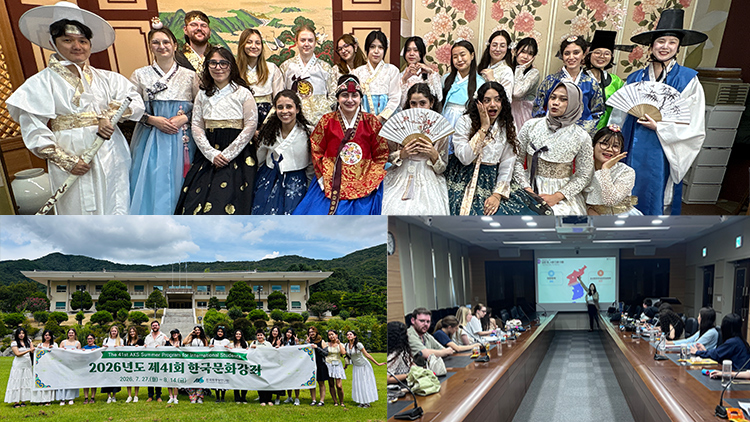
International Educational and Cultural Exchange in Korea (2026 AKS Summer Program) ⓒ The Academy of Korean Studies
When Korea shares these softer stories, it does not diminish its strength. It deepens it. Because what stays with us the longest is not what dazzles, but what makes us feel seen. A film can win awards, but a single scene can sit in your chest for years. A city can impress with its skyline, but it's the moment you're handed a warm drink on a cold street that you remember most.
I believe Korea's most lasting impact won't come from how loudly it speaks, but from how gently it listens how it continues to create spaces where people across oceans can feel less alone. Spaces where someone on the other side of the world can say, "I've felt that too," even if they've never set foot in Seoul.
In the end, the most powerful image Korea can offer the world is not just one of success, but of shared humanity. A reminder that even in a fast-changing world, there is still room for stillness. For care. For stories that don't shout, but stay.
And when someone thinks of Korea, not just as a place but as an experience, I hope they remember how it made them feel understood without needing to understand every word. I hope they carry with them not the spectacle, but the stillness the quiet gesture, the unspoken care, the sense that someone, somewhere, saw them. Let them remember not only how Korea shaped the world, but how it welcomed those who arrived quietly, with open hands. Not through grand declarations, but through warmth, presence, and grace. And let them remember that in those small, unforgettable moments, they found something that felt like home.