The textbooks Voyages in World History and Ways of the World: A Global History with Sources are world history textbooks for American high school students. In the 2023 editions of these textbooks, descriptions of South Korea’s democratization, the representation of Korea on a historical map, content related to Japan’s colonial rule of Korea, and descriptions of the spread of Korean popular culture were revised and supplemented. In addition, new material illustrating Confucian education in 18th-century Korea was included. These are some of the key examples identified through exchanges with textbook authors and publishers as part of textbook improvement initiatives, including invitation programs and on-site visits conducted under the “Understanding Korea Project.”
- Revisions to the Description of South Korea’s Democratization| The period of authoritarian rule combined with economic growth was revised from 1988 to 1987, and the description of the democratization process was supplemented.
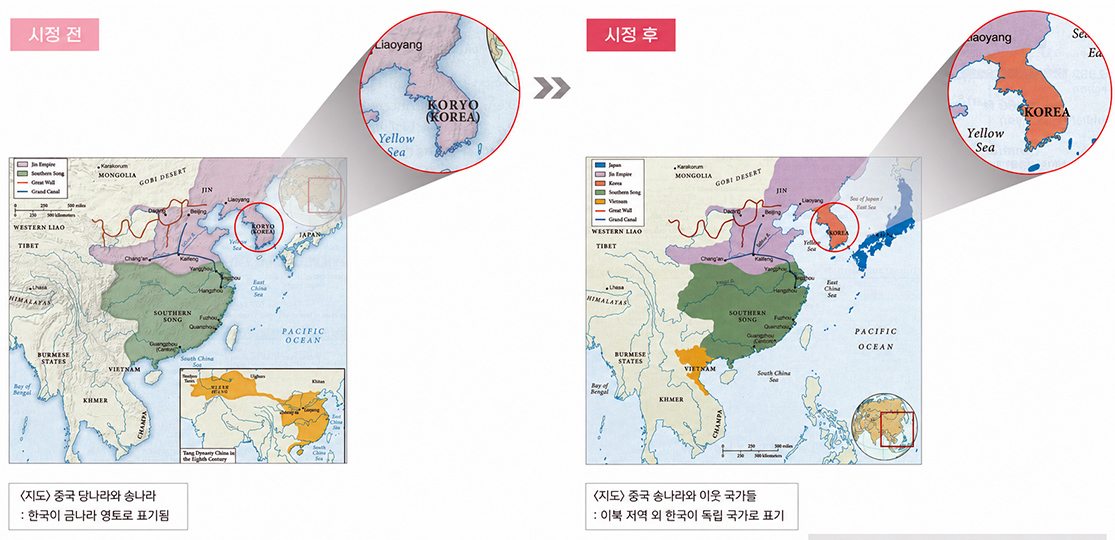
- Improvements to the Representation of Korea on a Historical Map| The Korean Peninsula, previously shown in the same color as the Jin Empire, was distinguished by a different color, and “Korea” was added as a separate entry in the legend.
- Supplementary Descriptions Regarding the Japanese Colonial Period| Content on land issues related to Japan’s colonial rule of Korea, the peaceful protest movement in 1919 and its suppression, policies aimed at eradicating Korean national identity, and Korean “comfort women” was added.
- Revisions to the Description of the Spread of Korean Popular Culture| The description was expanded from a focus on East and Southeast Asia to a broader scope extending far beyond Korean borders.
- New Material on Confucian Education in Korea| An image illustrating Confucian education in 18th-century Korea and an accompanying explanation were newly included.
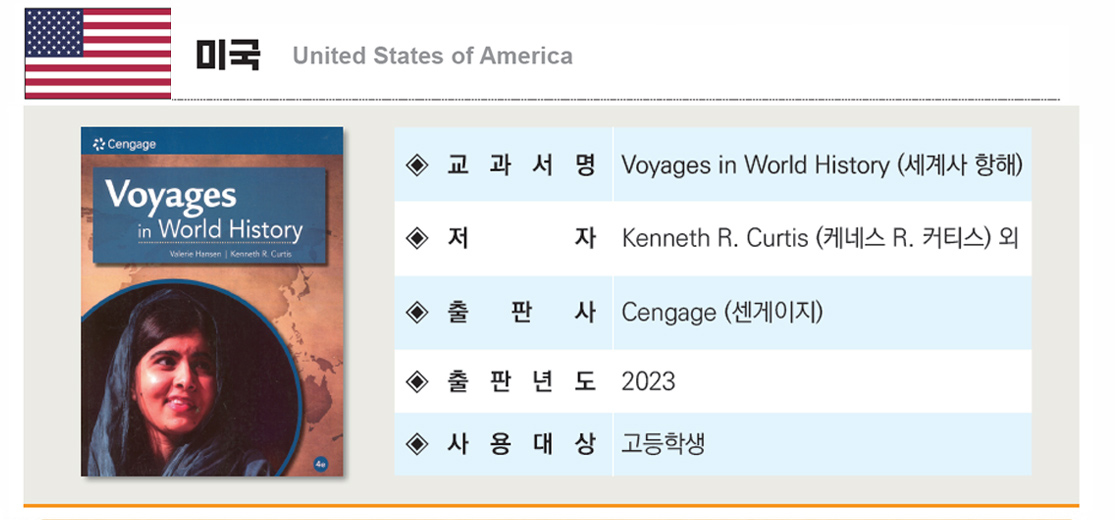
Key Example 1. Revision of the Timing and Description of South Korea’s Democratization
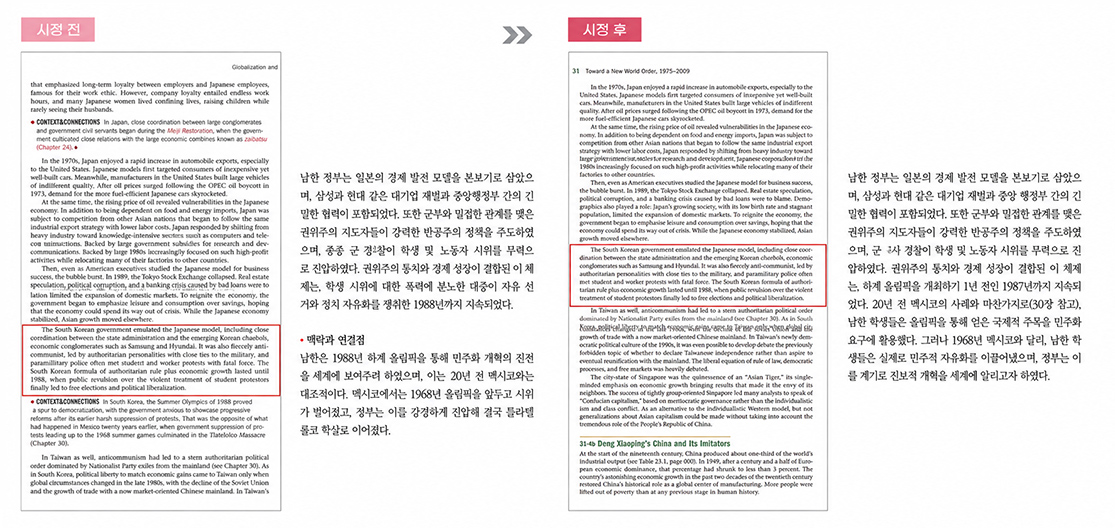
In the 2023 edition of the high school world history textbook Voyages in World History, published by Cengage, content related to modern South Korean history was revised. The previous edition described the system combining authoritarian rule and economic growth in South Korea as having continued until 1988, while the 2023 edition revised the date to 1987.
The revised edition also describes how, in the run-up to the 1988 Seoul Olympics, South Korean students used the international attention surrounding the Games to advance their calls for democratization and helped bring about progress toward democratic liberalization. The textbook also explains South Korea’s democratization process by comparing it with the protests that took place before the 1968 Mexico Olympics.
Key Example 2. Revisions to the Representation of Korea on a Historical Map
In Ways of the World: A Global History with Sources, published by Bedford, Freeman & Worth in 2023, the representation of Korea on an East Asian historical map was also revised. In the original map, the Korean Peninsula was shown in the same color as the Jin Empire, and Korea was not separately identified in the legend.
On the revised map, the Korean Peninsula is shown in a different color from the Jin Empire, and “Korea” has been added as a separate entry in the legend. Meanwhile, the incorrect coloring of Jeju Island was also communicated to the author and publisher, and the author indicated that it would be corrected in a future edition.
Key Example 3. Supplementary Description of Japan’s Colonial Rule of Korea
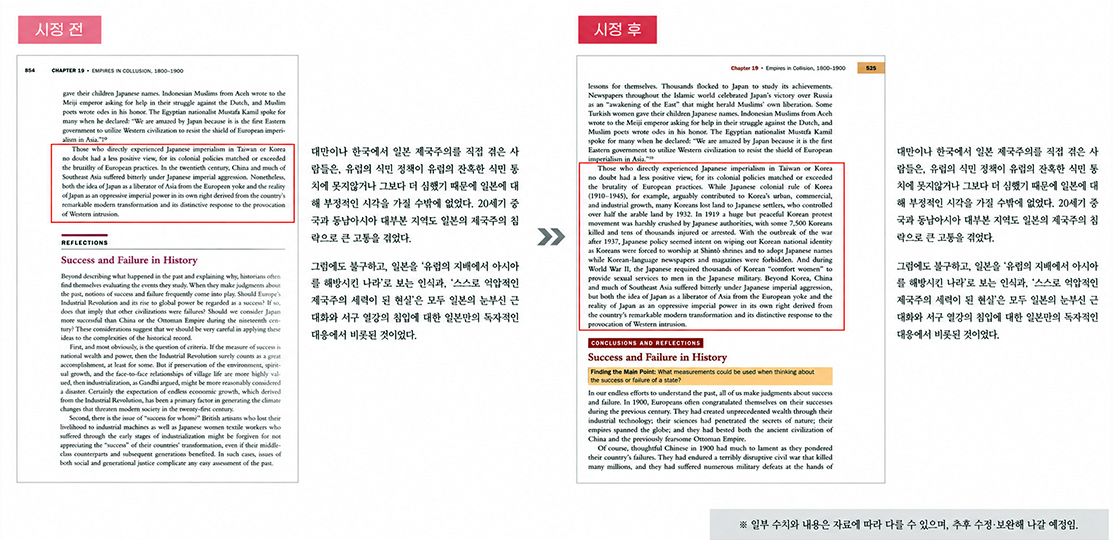
In the same textbook, the section explaining Japanese imperialism was supplemented with more specific information about Korea’s colonial experience. The previous edition briefly noted that those who directly experienced Japanese imperialism in Taiwan or Korea had a less positive view of Japan as a result of its colonial policies.
In the revised edition, Japan’s colonial rule of Korea (1910–1945) is presented as a separate case, with additional information on land ownership issues affecting Koreans; the large-scale peaceful protest movement in 1919 and its suppression by Japanese authorities; policies implemented after 1937 aimed at eradicating Korean national identity, including forced worship at Shinto shrines and the adoption of Japanese-style names; and the banning of Korean-language newspapers and magazines. Information about Korean “comfort women” during World War II was also included.
Key Example 4. Revision of the Description of the Spread of Korean Popular Culture
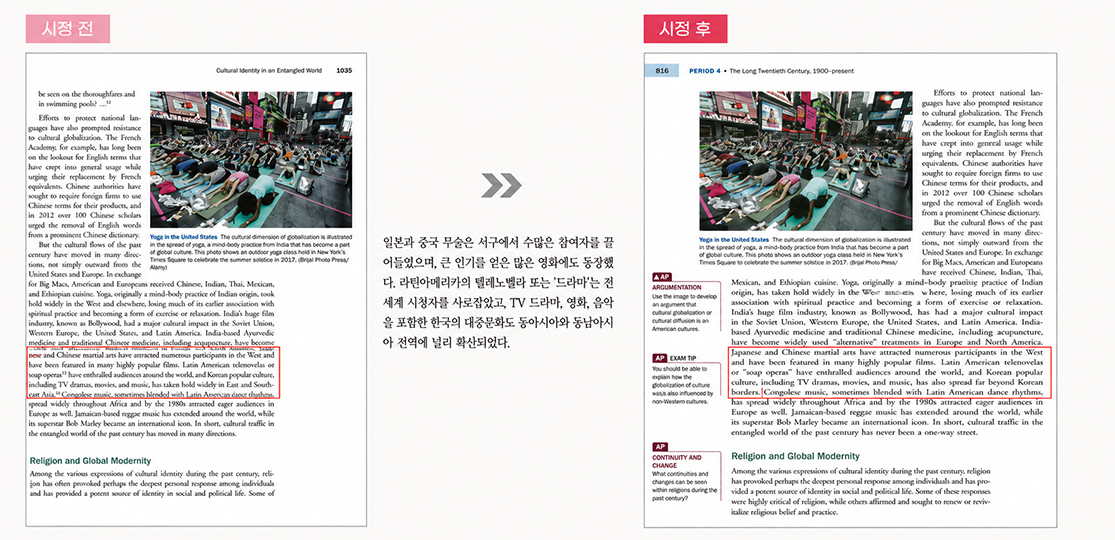
The wording used to describe the spread of Korean popular culture was also revised. The previous edition stated that Korean popular culture, including TV dramas, movies, and music, had “taken hold widely throughout East and Southeast Asia.”
In the revised textbook, this was changed to state that Korean popular culture has “spread far beyond Korean borders.”
Key Example 5. New Material on Confucian Education in 18th-Century Korea
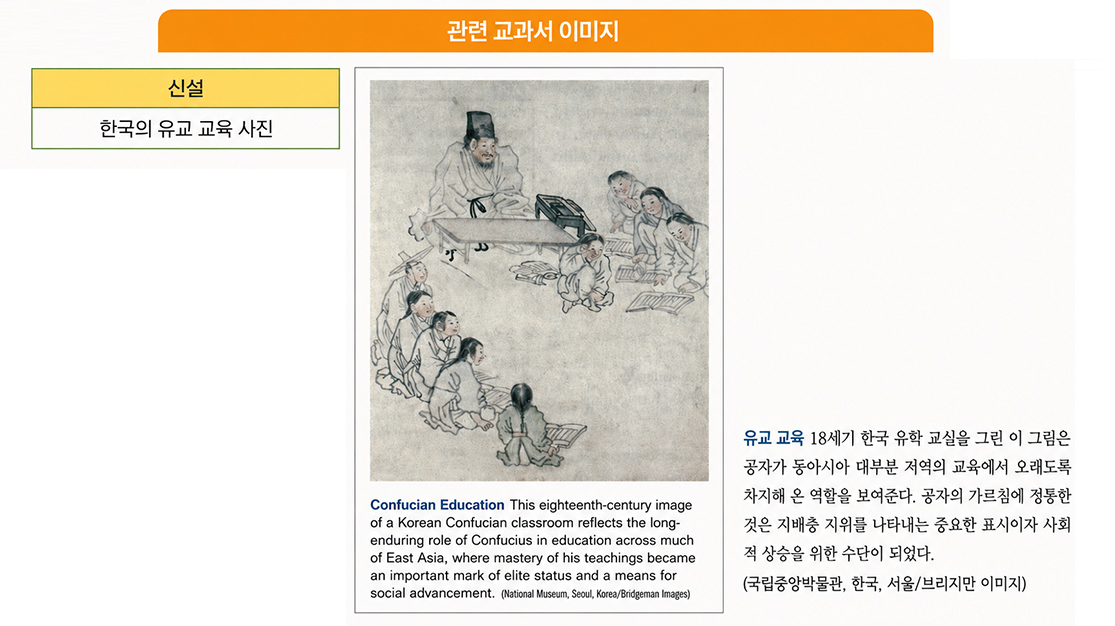
The revised edition of Ways of the World also includes new visual material related to Korea. The textbook features an image of an 18th-century Confucian classroom in Korea, accompanied by an explanation of the long-enduring role of Confucius in education across much of East Asia.
The explanation notes that mastery of Confucius’s teachings became an important mark of elite status and a means for social advancement. The image is credited to the National Museum of Korea, Seoul, South Korea/Bridgeman Images.
- Revisions to Descriptions and Labels | Descriptions of South Korea’s democratization and the labeling of Korea on a historical map have been revised.
- Supplementary Descriptions | More detailed explanations of Japan’s colonial rule of Korea have been added.
- Revision to the Description | The description of the spread of Korean popular culture has been revised from a focus on East and Southeast Asia to one extending far beyond Korean borders.
- New Material on Korea | New material illustrating Confucian education in 18th-century Korea has been included.