
1. Results of the 2026 European Education Cooperation Program and Textbook Improvement Activities
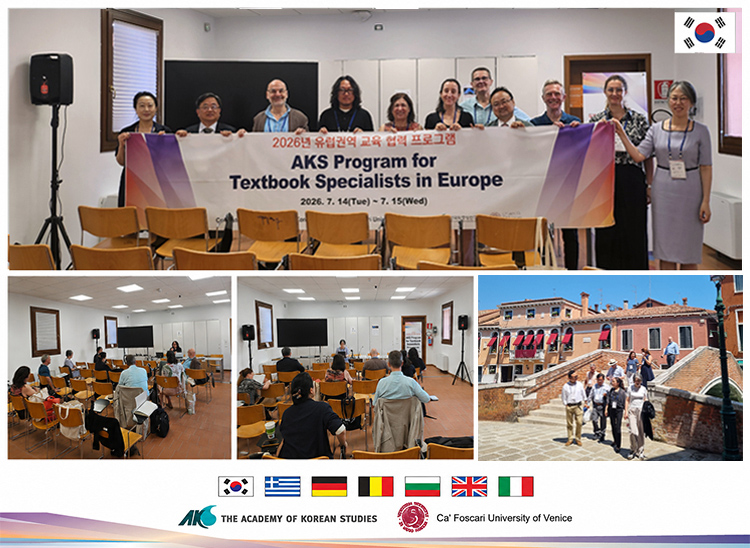
The “Understanding Korea” project office of the Center for International Affairs (CEFIA) at the Academy of Korean Studies (AKS) hosted the 2026 European Education Cooperation Program at Ca’ Foscari University of Venice, Italy, on Tuesday, July 14, and Wednesday, July 15, and held a roundtable discussion with education and textbook experts in Milan, Italy, on July 17.
The European Education Cooperation Program examined how recent changes in curricula and educational environments in major European countries (Greece, Germany, Bulgaria, Belgium, the United Kingdom, and Italy) affect the inclusion and utilization of Korea-related content and discussed ways to broaden the scope and depth of Korea-related education in European textbooks and classrooms.
In addition, the program shared insights into the trend toward the diversification of Korea-related education in Europe, as reflected in the portrayal of Korea in European textbooks, along with case studies and achievements resulting from collaboration with textbook experts worldwide. Through this program, the aim is to link European textbook experts with the network of European scholars of Korean studies to disseminate the achievements of the “Understanding Korea” initiative and provided an opportunity to further strengthen future cooperation.
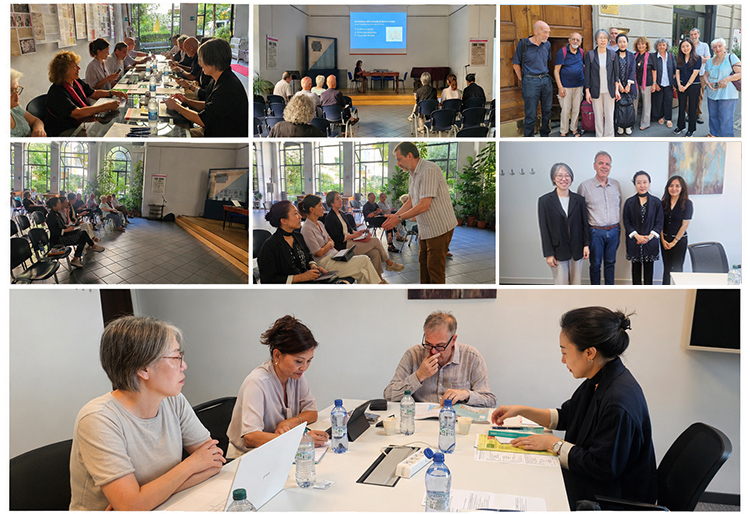
In Milan, a roundtable discussion was held with education and textbook experts from IRIS, Clio ’92, and UFN, as well as textbook authors, to advance efforts to improve textbooks. During the roundtable, the need for a multifaceted approach to improve Korea-related content in Italian textbooks in response to changes in the local environment, such as the recent revision of national guidelines for the Italian curriculum, the participants recognized the need for a multifaceted approach.
Capitalizing on the high level of interest in Korea in Italy, AKS plans to strengthen cooperation with Italian textbook experts not only to improve Korea-related content in textbooks but also to identify and develop Korea-related content that can be utilized in educational materials and in the classroom.
2. 20 Korean Folktales and Myths Featured in 14 Educational Materials across 5 Latin American Countries
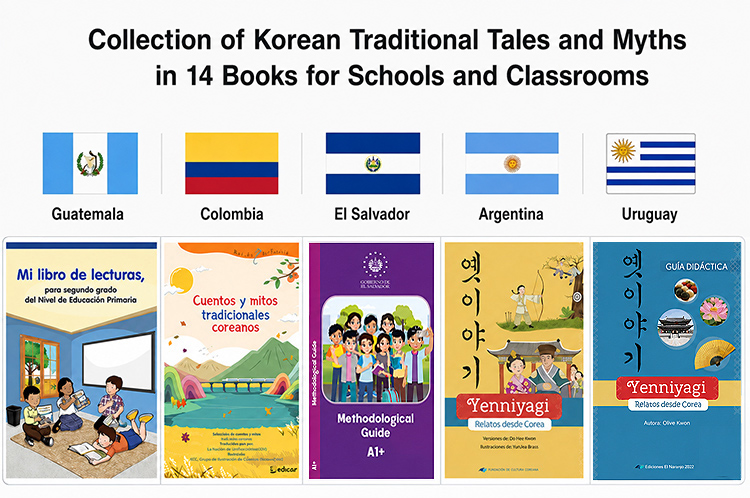
Through the Academy of Korean Studies (AKS) foreign textbook improvement initiative, 20 traditional Korean folktales and myths, including “The Tale of Simcheong,” “The Tale of Chunhyang,” “Heungbu and Nolbu,” “Kongjwi and Patjwi,” and the Dangun myth, are now featured in a total of a total of 14 textbooks, teaching materials, and teacher’s guides in the following 5 Latin American countries: Guatemala, Colombia, El Salvador, Argentina, and Uruguay.
The inclusion of Korean stories in Latin American educational materials began in 2016 with the introduction of the myth of Bak Hyeokgeose in a Guatemalan digital textbook. Since then, Korean folktales and myths have been continuously added to elementary and secondary education materials. In addition, “The Hare and the Tortoise” has been translated and published in four Mayan-language textbooks. In 2024, Yenniyagi, a collection of 10 traditional folktales and founding myths, was published in Argentina, and in Colombia, Traditional Folktales and Myths of Korea for elementary school students was co-produced with a local publisher.
Since then, its scope of use has continued to expand. In 2025, Yenniyagi was added to Biblioteca País, Uruguay’s national integrated digital library, allowing anyone, including students and teachers, to access Korean folktales and founding myths. In El Salvador, traditional Korean folktales such as “Heungbu and Nolbu,” “The Grateful Tiger,” and “The Green Frog” were included in teachers’ instructional guides.
These achievements demonstrate how the “Understanding Korea” project—which has focused on correcting historical and economic inaccuracies and expanding content—has broadened its scope to include cultural content such as Korean folktales and myths. This is particularly significant because the cooperative relationships with overseas education and publishing professionals, established through training programs for textbook experts and local textbook seminars consistently organized by the AKS, have led to the actual development of textbooks and educational materials.
As of August 14, 2026, this achievement has been featured in more than 15 media reports. Details on the cases covered by country and the project implementation process can be found in the articles listed below.
· University News Network | 20 Korean Folktales and Myths Included in Educational Materials across Five Latin American Countries
· Seoul Economic Daily | Korean Folktales Featured in Textbooks across Five Latin American Countries
3. Results of The 41st AKS Summer Program for International Students
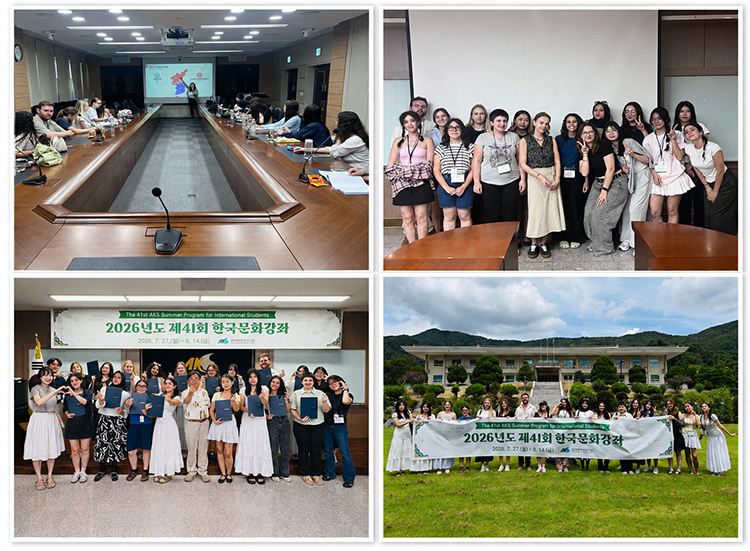
In August 2026, the Center for International Affairs at the Academy of Korean Studies held the 41st Korean Culture Course. Since 1993, the Korean Culture Course has been offered annually to international undergraduate students majoring in Korean Studies at universities overseas. To date, approximately 1,051 students have participated in the program.
This year, 17 undergraduate students from 17 countries participated in the three-week program, studying the Korean language and Korean Studies while experiencing various aspects of Korean culture. All participants were Korean Studies majors at universities outside Korea and joined the program to deepen their understanding of Korean Studies and explore their future paths as the next generation of Korean Studies scholars.
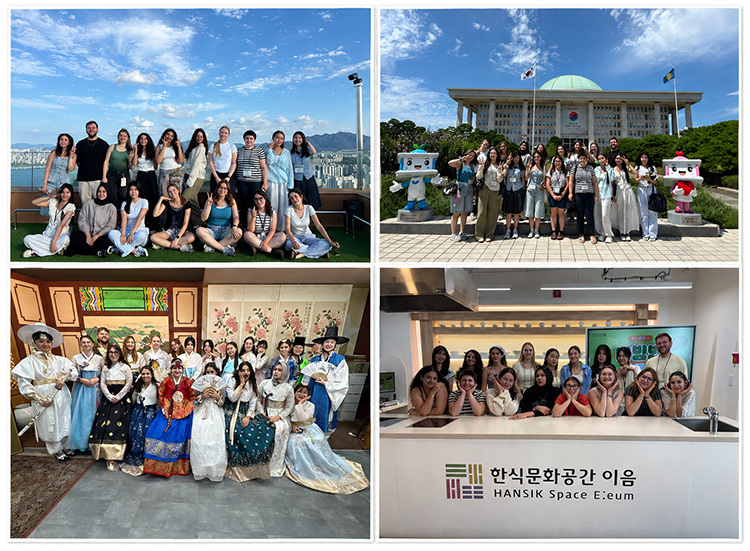
Participants improved their Korean-language skills through classes tailored to their
proficiency levels and attended special lectures on Korean history, culture, and the
arts. They also visited the National Folk Museum of Korea, Korean Food Culture Space
E:eum, Changdeokgung Palace, HiKR Ground, the National Assembly, and the Korea Confucian
Culture Agency in Nonsan, gaining first-hand experience of Korea’s traditional and
contemporary culture.
The course provided participants with an opportunity to deepen their understanding of
Korean Studies by experiencing Korean history and culture beyond the classroom. It is
hoped that they will continue to strengthen their academic capabilities, develop into the next generation of Korean Studies scholars, and contribute to the development and
expansion of Korean Studies in their respective fields.
4. The 13th World Congress of Korean Studies
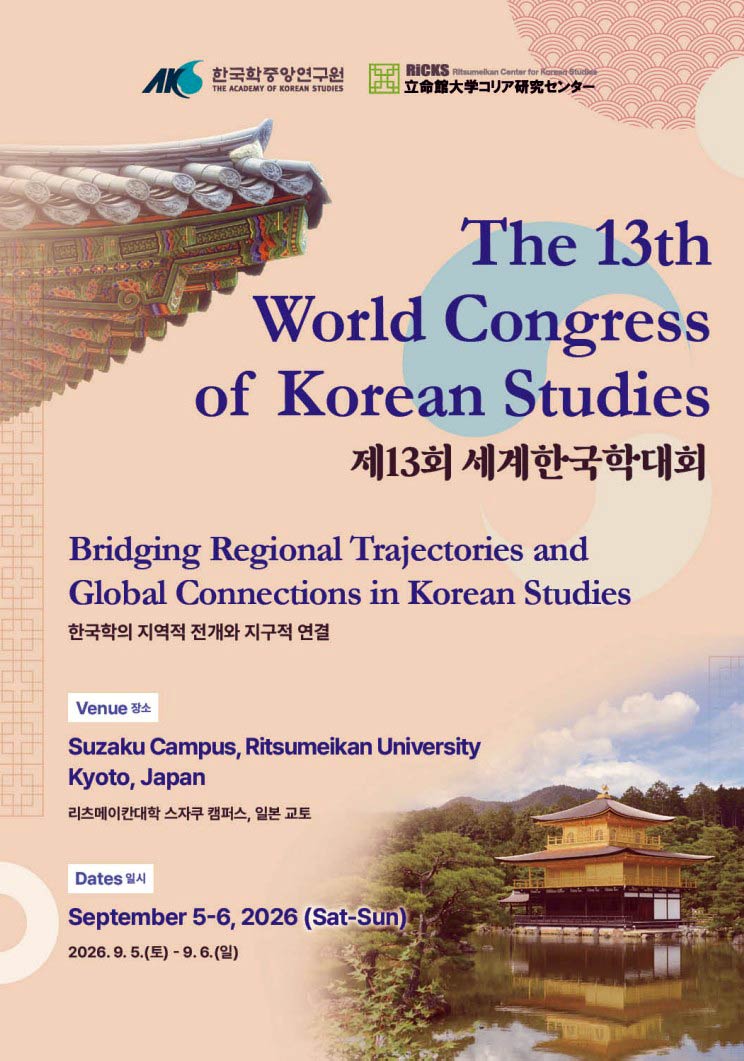
The Academy of Korean Studies, in collaboration with the Ritsumeikan University Korea Research Center, will host the 13th World Congress of Korean Studies from September 5 to 6, 2026, at the Suzaku Campus of Ritsumeikan University in Kyoto, Japan.
Under the theme "Bridging Regional Trajectories and Global Connections in Korean Studies," the Congress will bring together scholars of Korean Studies from around the world to present their latest research and exchange academic perspectives. In particular, the Congress will provide an opportunity to discuss regional developments in Korean Studies and explore sustainable approaches to the global advancement of Korean Studies.
We cordially invite scholars, students, and all those with an interest in Korean Studies to participate in this international academic event.