Hallyu has spread around the world and created great interest in Korean pop music, dramas, and cultural sites, but the history of Korea has not been caught up in the fervor. American teenagers know a lot about BTS, Blackpink, kimbap, bbq pork belly, and choco pie; they dress up in hanbok when they visit Korea, but they do not know much about the actual clothing or the sites they visit.
Beyond what they can see and hear, they embrace Korean culture without the history because it is not taught in American high schools (other than the Korean War) and is a niche subject at university.
"In American education, we should make the effort to teach our students about events of Korean history that not only reflect the truth of how Korean society developed in the 20th century but also connect to the world those students live in today."
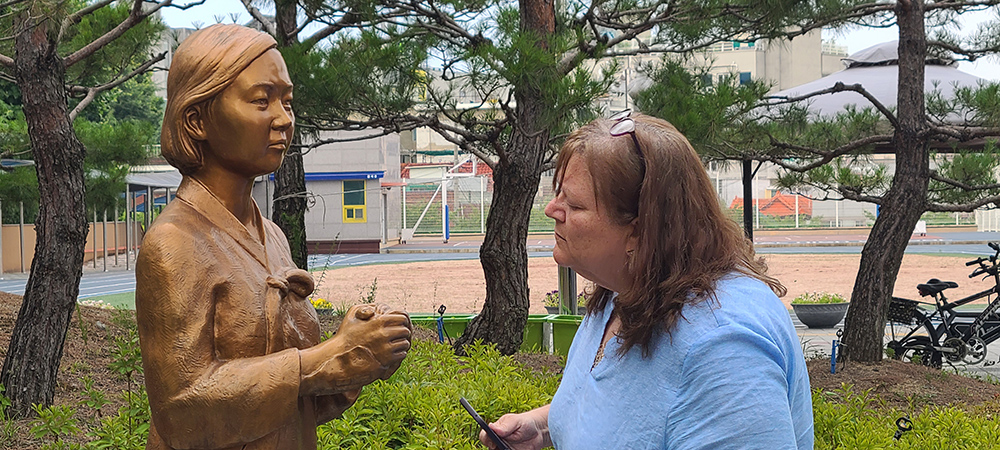
Figure 1: The author with Sonyeosang of wianbu / activist Lee Yong-soo at Daegu Girls' Commercial High School. The artist is Lee Byeong-jun [photo by Ahn Jin-seok].
My Understanding Korea grant resulted in a project that has two parts: 1. It is a brief textbook that is an overview of the wianbu (“comfort women”) for older teens who are mature enough to absorb the history intellectually and 2. it showcases statues of wianbu that are installed around Korea that function as public art, activist art, and storytelling.
As students will likely be encountering the story of the wianbu for the first time, the brief historical overview coupled with the statues will allow them to understand what happened without being bogged down by a lot of reading. They can engage with the material more easily because of the text and visual combination.
In the 20th century, especially during the last three years of World War Two, the Japanese military trafficked hundreds of thousands of women on military installations across Asia to be sex slaves; most of the women were Korean, but many were from other countries such as China, Indonesia, the Philippines, Taiwan, the Netherlands, and even Japan.
Although this subject is difficult and even frightening, it must be shared with young people to help them understand the realities of human trafficking in recent history and in the present time. The wianbu who became activists from the early 1990s declared that in addition to wanting justice for what the Japanese military did to them, they wanted their audience to confront current human trafficking and work to stop it.
Out of 200,000-400,000 women trafficked during World War Two, there are five wianbu alive in Korea today (scholars believe there are none alive in North Korea); China had seven survivors as of spring, 2025; there may be two dozen or so in the Philippines; there are no survivors in Taiwan or Japan; if there are any survivors in Indonesia, they are currently unknown.
It is my intention that my short textbook will keep the story of these women going for a long time, while the students who learn about them will honor their memory and become the generations that work to eradicate human trafficking around the world.
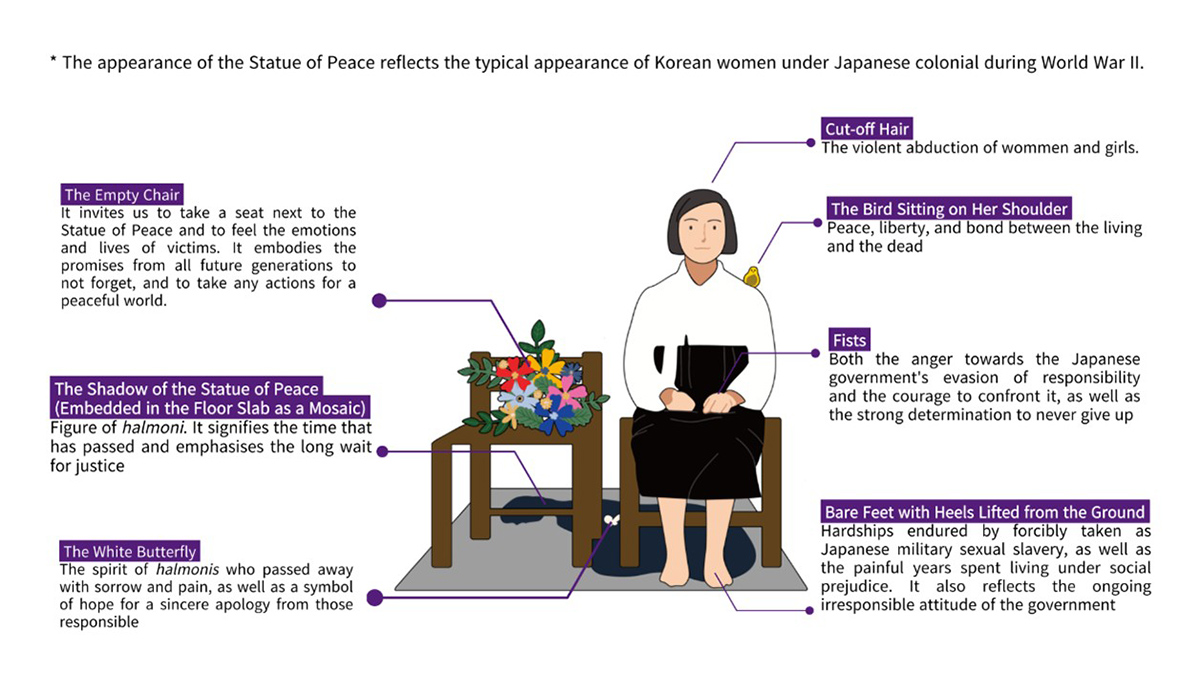
This graphic, by the Woman and War Museum, explain the installations:
Below are some of the Sonyeosang I visited in the summer of 2024. The installations encourage engagement with the horror of what the women endured and ask viewers to take part in the modern justice movement. Each installation features the statue of a girl (or grown woman) and a short text that explains who she is and why she is there. There is also a plaque that names the artist, the organization that paid for the statue, and often includes the names of donors. Some installations include poems, calls for justice or activism, or multiple girls.
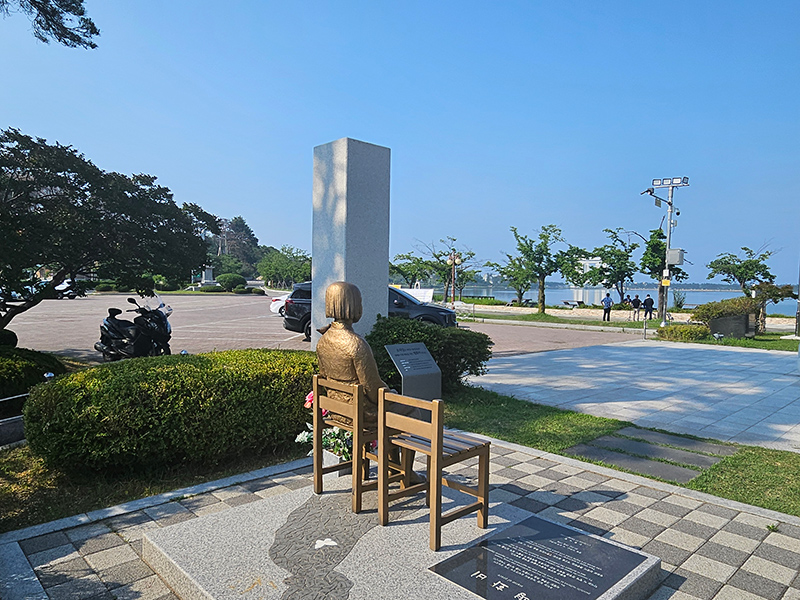
Figure 2:
The city of Gangneung, located on the East Sea, placed its Statue of Peace so she is looking across the water towards Japan, staring until it relents and apologizes. Artists: Kim Seo-kyung and Kim Eun-sung.
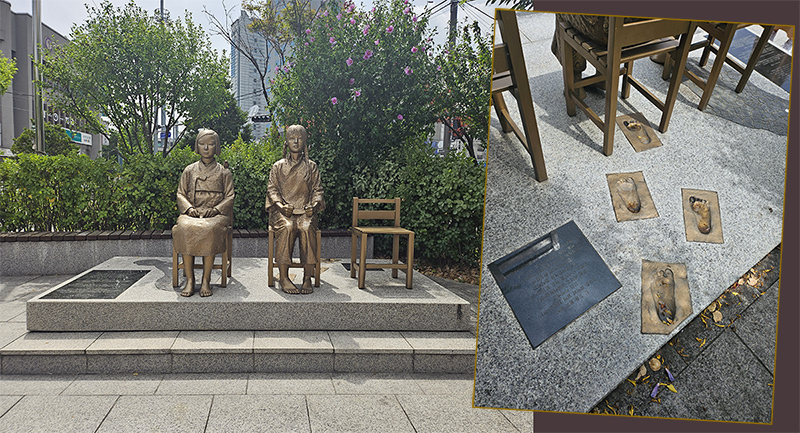
Figure 3:
At the entrance to the main shopping area of Itaewon, Seoul, this installation features a Korean girl and a Chinese girl with an empty chair. Both girls’ hands are clenched, but the Chinese girl’s fists seem ready for a fight. Behind the Chinese girl, there are footprints; on the plaque next to the footprints, the missing friend wants them to know she was there and that their story is her story, too. A replica of this installation can be found in Shanghai. Artists: Kim Seo-kyung and Kim Eun-sung.
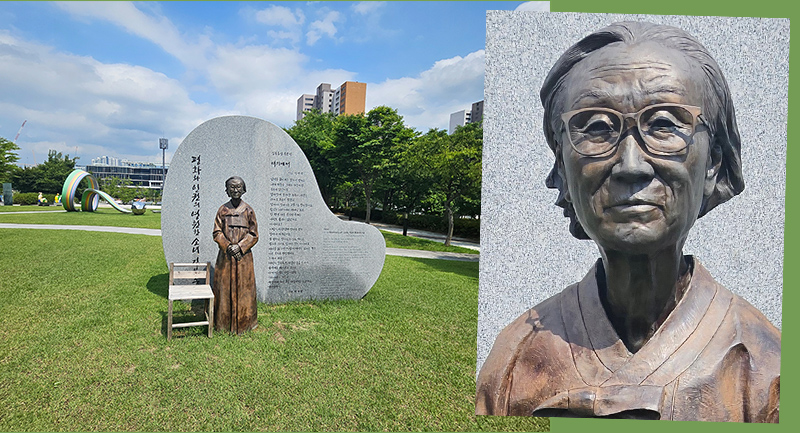
Figure 4:
In front of the Icheon Cultural Arts Center, artist: Ahn Gyeong-shin. The silhouette of a young girl is outlined in wianbu Kim Bok-dong’s hair. The installation includes a poem: “Here- –In Memory of Lady Kim Bok-dong” by Lee Byungchang.
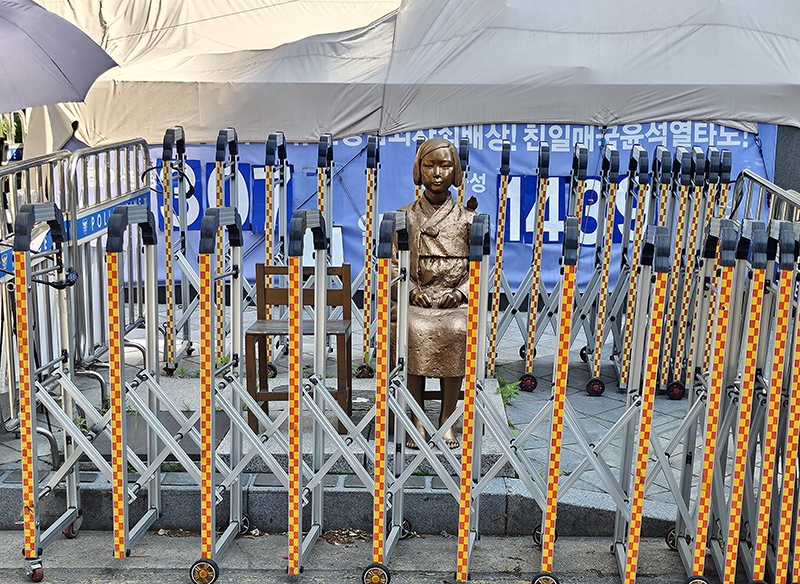
Figure 5:
the first of the Sonyeosang in Seoul, close by Gyeongbukgong and in front of the site of the former Japanese embassy. Artists: Kim Seo-kyung and Kim Eun-sung.
Note: Photos of the Sonyeosang were all taken by the author.