

Essay Contest Result
International Images of South Korea
: A Glimpse of Folkloric Mysticism Beyond K-pop and Technology

In recent years, most countries have come to value their international image nearly as much as their hard power. This global image is associated with soft power, a term coined by Joseph Nye in the late 1990s in his book Soft Power, which describes the attractive cultural, economic, and political aspects a country offers to the rest of the world, standing in contrast to military might (Nye, 1990). Soft power adds tremendous value to a nation’s global assets, often bringing not only tangible benefits but also intangible wealth. However, it is the way this image is created, through education and media, that shapes how the world sees and understands a country, revealing the need for broader, more inclusive representation.
This essay will examine the international image of South Korea as presented in educational textbooks, media, and websites, and how this image contributes to the global understanding of the country. Currently, South Korea is mostly associated with modern technology and popular culture, which, although effective, presents a one-dimensional picture. The main purpose of this essay is to explore how the international image lacks the presence of Korea’s folklore, which could significantly enrich and deepen the understanding of its culture, going beyond usual connotations with K-pop (Korean music genre) or K-dramas (Korean TV shows). The hypothesis is that incorporating Korean folklore, especially in the form of a regional tourist guidebook, could enhance South Korea’s global image by portraying it as a nation rich in spirituality, diversity, and tradition.
The Present International Image
The international image of South Korea, developed over decades since it began to rise on the global stage, reflects only part of its identity. Today, South Korea is primarily known for the unresolved conflict with North Korea and the accompanying nuclear threat, its cutting-edge technology, and its dynamic popular culture (K-pop, K-drama, K-fashion). These features showcase its strength as an economic powerhouse and a key player in the global value chain (GVC), but they present a partial narrative.
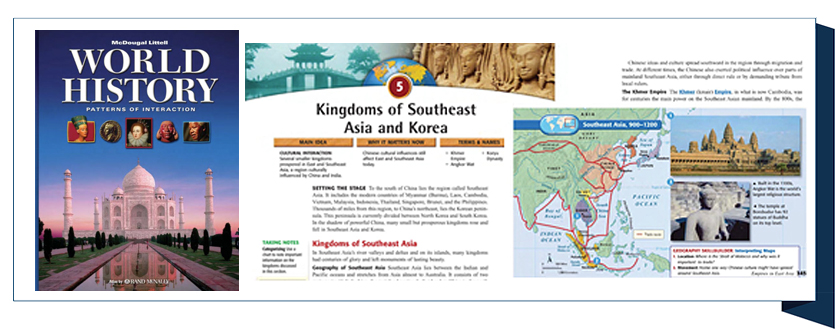
For this essay, three main sources were analyzed: the high school textbook World History: Patterns of Interaction by McDougal Litell, news coverage from the BBC, and the Encyclopedia Britannica page on South Korea
In the textbook World History: Patterns of Interaction, Korea is mentioned in the context of the legendary founder Dangun (c. 2333 BC), the Korean War (1950-53), Japanese occupation (1910-1945), and as a Cold War battleground. Its premodern history is reduced to a brief mention of the Unification of Silla and Goryeo’s cultural ties with China (Song and Tang Dynasties), with only a few lines on celadon pottery and the Tripitaka Koreana (Korean collection of Buddhist scriptures carved onto wooden printing blocks), and a passing reference to the Joseon Dynasty (Littell, 2017). This minimal coverage means not only is history truncated, but culture, especially folklore, is almost completely omitted, signaling its secondary importance in the global narrative.
In BBC news and articles, South Korea is typically featured concerning the North Korea threat, foreign politics, technological innovation, economic development, and, occasionally, the achievements of popular culture figures (for example: K-pop boy band BTS) or the skincare industry (BBC News). Yet, cultural heritage is either briefly mentioned or absent. The dominant narrative presents South Korea as a country of progress and modernity, but it rarely shows the mythic or spiritual layers that lie underneath.
Encyclopedia Britannica provides a broader overview, with dedicated sections on “History”, “Government and society”, “Economy”, and “Cultural life”. While the “Cultural life” section includes information about the arts, social customs, and institutions, there is still little to no reference to mythology, legends, or the folkloric universe, components that could significantly deepen global understanding of Korea’s cultural heritage (Encyclopedia Britannica).
In contrast, it is worth mentioning that in the same sources, other East Asian countries such as China and Japan are more frequently represented in cultural contexts, including traditional beliefs and mythology. Terms related to folklore and spiritual heritage appear more often, which suggests that these countries have already managed to integrate their traditional narratives into their global cultural presence. This highlights the relative absence of Korean folklore and its symbolic universe in the international discourse, which could lead to an incomplete understanding of South Korea’s cultural depth.
Why Is It a Problem?
This lack of representation creates a serious problem: it narrows down the perception of South Korea and reduces the complexity of its culture, making it an economic powerhouse deprived of spiritual profundity. While the emphasis on strength and pop culture is effective, these elements don’t carry emotional or symbolic narratives that folklore and mythology provide. Without these deeper, spiritual stories, South Korea risks being misunderstood, or worse, seen as a band rather than a nation with soul and history.
Myths and legends are not merely stories – they are cultural memory, reflections of identity, and emotional codes. When they are left out of a country’s international image, that country loses the chance to build long-lasting, human connections with global audiences. Folklore could serve as a bridge between modern South Korea and its spiritual roots, giving space for viewers to connect with the country on a more intimate, human level.
Folklore as an Alternative
Folklore, or minsok (민속, 民俗), literally meaning “people’s customs”, refers to the beliefs, legends, and spiritual traditions rooted in everyday life and regional identity. It carries a unique emotional charge that helps connect people not only with the past but also with the places and values those stories emerged from (Cheon, 2013).
Recently, there has been a growing global interest in folklore and mythology, which can be seen in various cultural products, including the 2025 Netflix release, K-pop Demon Hunters, that introduced elements of traditional Korean myths and spirits to wider audiences (Korea.net, 2025). Although such representations of folkloric creatures are often aestheticized or simplified, they reveal an untapped potential and growing curiosity toward Korean mythological worlds.
Incorporating folklore into South Korea’s international image would fill the cultural gap left by current representations and give them an opportunity to offer something both profound, timeless, and captivating. Unlike popular culture alone, folklore can function as an educational and emotional instrument, helping people form a more personal and layered connection with South Korea. It shows the country not only as modern and dynamic, but also as spiritually rich and historically complex.
Proposal for a New Instrument
This essay proposes the creation of a Korean Folklore Tourist Guidebook titled Korea Through Legends – a regional travel guide that links myths, local legends, and spirits to specific areas of South Korea.
The guidebook would feature a map of South Korea, divided by regions, each paired with legendary creatures and stories from that area. In each section, a creature or figure from folklore would narrate its story and explain its connection to the land, culture, and atmosphere of that region. This would allow readers to form emotional connections with Korea’s geography through storytelling, linking myths to actual places and traditions. This way, the guidebook would tie all these elements together to create a means for strengthening the international image of South Korea and improving its understanding.
For instance, Jeju Island could be introduced through the myth of Samseonghyeol (삼성혈), which would be narrated by one of the three mythical demigods of Jeju (Cheon, 2014). Emerging from the ground, the figure could speak directly to the reader and introduce the origin myth of Jeju, their role in it, and then describe the geography, atmosphere, and cultural uniqueness of the island. The guide would thus combine mythology, geography, and cultural identity into a single narrative experience.
The guidebook could serve multiple purposes – as an educational resource in international schools and universities, a cultural literacy tool on educational platforms, a soft power instrument in embassies and Korean Cultural Centers, or a promotional product in airports and tourist hubs, available in multiple languages.
This instrument would humanise South Korea’s image, expand it beyond technology and entertainment, and show the country’s roots, beliefs, and hidden depth. It would also support lesser-known regions by tying them to captivating narratives, potentially drawing tourists to explore beyond Seoul and Busan. In an engaging and personal way, it would give voice to Korea’s spirits, creatures, and forgotten heroes, letting them speak again to the world.
Conclusion
To conclude, the international image of South Korea is vivid but incomplete. While the focus on modernity and entertainment has global appeal, it leaves out a vital part of Korea’s identity – its myths, spirits, and symbolic heritage. In a world increasingly dominated by technology, there is a growing hunger for stories that speak to our deeper selves, for narratives that are emotional, mythical, and grounded in history.
Introducing Korean folklore into the country’s global narrative, as proposed through a regional guidebook in this essay’s hypothesis, could complete the image and offer something truly compelling, bringing back voices that have shaped its culture for centuries. Folklore is not only entertaining; it is healing, connecting, and unforgettable. In the age of soft power, cultural depth is a competitive advantage, and South Korea already has the stories.
It just needs to let them be heard.
[Honorable Mention]
Katarzyna Kloc
(Country of Activity: Poland)

Katarzyna Kloc
(Country of Activity: Poland)
