

Column
The supplementary document for understanding Korea at Cambodian secondary schools
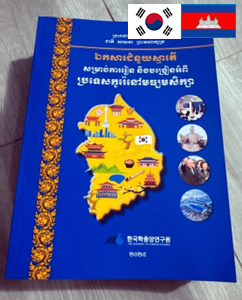 The project developed the Supplementary Document for Understanding Korea for Cambodian secondary schools, completing a full cycle from textbook review to classroom trials and finalization. In Phase I the team reviewed Korea-related units in Grade 10 Geography and Grade 11 History, held roundtable meetings in Phnom Penh, and ran provincial consultations in Kampong Cham and Kampot to refine content, layout, and pedagogy; a first draft and twenty bound review copies were produced. Phase II delivered teacher orientations, distributed materials, and conducted classroom trials and observations in three schools (Takeo and Prey Veng), where feedback from six teachers per school and about thirty students per class led to added visuals and interactive elements. The final Khmer document was prepared for SEMAB submission and planned dissemination via print and the MoEYS website; although the planned expert presentation was not held, the team reallocated funds to an additional consultant and completed all other core activities.
Methodology and Project Design
The project followed a two-phase approach beginning with Phase I (design and drafting), which established the working team, conducted a detailed review of Korea-related content in the Grade 10 Geography and Grade 11 History textbooks, and convened expert and stakeholder consultations to shape scope and pedagogy before compiling the first draft. Phase II (trial and refinement) focused on teacher orientations, classroom trials, structured observations and post-session interviews, and systematic incorporation of teacher and student feedback to finalize the material for submission and approval. Content development was organized into discrete geography and history modules aligned to the national curriculum, with an emphasis on clear explanations, strong visual supports (maps, photos, diagrams), and inquiry-based learning tasks to promote critical thinking. Quality assurance was maintained through iterative consultations with consultants and designers, pilot classroom uses to test usability and learning impact, and design calibration—editing, proofreading, and layout adjustments—to ensure the final document is accurate, relevant, and classroom-ready.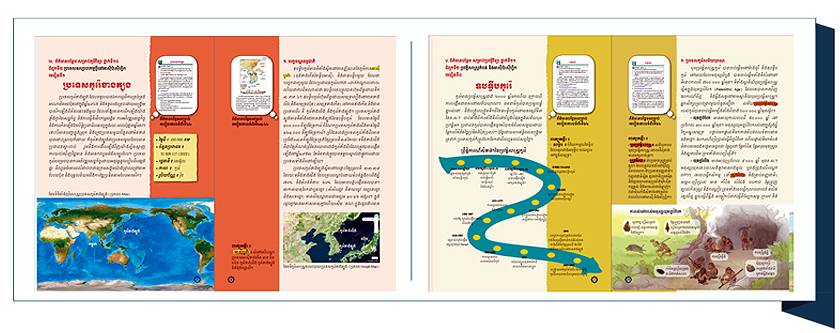
Why the Supplementary Document for Understanding Korea is relevant?
Geography and history of Korea are included in Cambodia’s Grade 10 Geography and Grade 11 History textbooks; however, coverage remains limited due to page constraints, outdated information, and a lack of visual materials. The Supplementary Document for Understanding Korea at Cambodian Secondary Schools addresses these gaps by providing comprehensive, curriculum-aligned lessons on Korean geography and history enriched with updated data, paintings, photos, maps, and graphics to improve comprehension. The geography section presents the natural environment, social systems, and recent economic development of South Korea, while the history section covers Korean prehistory, early periods of division and unity, the foundation of Korean civilization, Japanese occupation, and post–World War II transformation. Drawing on academic sources, credible websites, and research documents, the material supports teacher subject mastery and helps students gain broader understanding beyond the national curriculum. In the long term, deeper knowledge of Korea can strengthen Cambodia–Korea relations at people-to-people and governmental levels.The Effects of the Supplementary Document for Understanding Korea
The project builds teacher capacity by providing structured, accurate, visually supported content that enables inquiry, source analysis, and diverse pedagogy across Korea-related units. Therefore, the Supplementary Document for Understanding Korea enhances student learning by broadening understanding of Korea’s environment, society, economy, and historical transformations, strengthening global awareness and critical thinking. The material enriches the curriculum without overloading syllabi and serves as a model for future teacher guides and textbook modernization. Standardized resources promote equity across schools by giving teachers shared, high-quality materials that can be readily integrated into lesson plans and classroom practice. By improving public understanding of Korea, the project contributes to closer Cambodia–Korea relations and supports pathways for educational exchanges and collaboration.Potential for Expansion
As part of this expansion, the Supplementary Document offers both opportunities for curriculum expansion and a structured teacher development cascade. Adaptations can be made for lower secondary grades with simplified language and enhanced visuals, while Grade 12 extensions can explore comparative development, geopolitics, and contemporary social issues. Cross-subject integration is feasible in civics, economics, and arts, and digital formats such as ebooks, LMS modules, and interactive tools can support blended learning.To ensure effective classroom use, a train-the-trainer program certifies provincial master trainers in both content and pedagogy. These trainers mentor school-based educators through workshops, practicums, and cycles of co-planning, demonstration lessons, peer observation, and targeted feedback. Professional learning communities meet monthly to refine lesson adaptations, analyze student work, and share resources, supported by a standardized pack of slides, worksheets, and formative checks. Progress is tracked through dashboards and observation data, feeding into refresher courses and annual calibration.
Together, expansion pathways and the teacher development cascade position the document not only as a supplementary resource but also as a sustainable framework for curriculum modernization, professional growth, and intercultural education. Partnerships with AKS, universities, and NGOs can amplify impact through workshops, exhibitions, and teacher showcases, ensuring long-term relevance and national scaling.
Conclusion
This initiative operationalizes intercultural education by integrating Korea Understanding into Cambodian secondary classrooms through a practical, curriculum-aligned supplementary document. The two-phase methodology—co-design and consultation followed by classroom trials and evidence-based refinement—ensures rigor and relevance. As an interim pedagogical support and a model for future teacher guides, the document advances curriculum sufficiency, teacher capacity, and students’ global citizenship competencies. With SEMAB approval, systematic teacher development embedded within the expansion strategy, and sustained MoEYS–AKS collaboration, the material is positioned for national scaling and long-term impact.
