

Culture Focus
Education in Korea - 3
Expansion of Higher Education, the Korean SAT
The July 30 Educational Reform: Expansion of Higher Education
In 1980, the July 30 Educational Reform (7.30 Educational Reform) was announced by the Special Committee for National Security Measures. This reform centralized the administration of college entrance examinations, transferring them from individual schools to the state. Previously, the Government Qualifying Examination under the Park Chung-hee regime (1963–1979) had been inadequate as a screening tool, making the universities’ Final Selection Test critical. The reform eliminated both the state-sponsored preliminary test and the Final Selection Test, replacing them with a single College Entrance Achievement Test, which became the sole entrance examination. Although its content was similar to the previous preliminary test, its importance was significantly elevated, signifying increased state control over the college admissions process.The most significant background of this reform was the rapid growth in the number of high school students.
The expansion focused on secondary education gradually moved to the expansion of higher education. More and more students continued to pursue college degrees and advanced degrees. The college admission system was reformed and more universities were established. The number of higher education institutions was 80 in 1960 and increased steadily to 372 in 2000, and 430 by 2019.
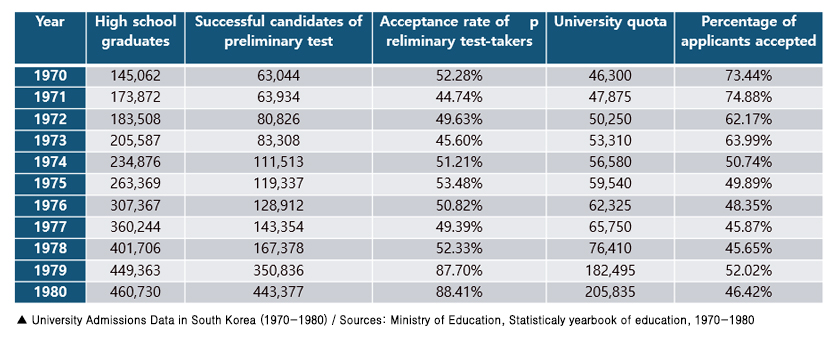
Table 4 presents data on high school graduate numbers, preliminary test results, and university admission statistics in South Korea between 1970 and 1980. As this table shows, the number of graduates grew from 145,062 in 1970 to 460,730 in 1980, a significant expansion of secondary education over that decade.
This means that high school graduates increased significantly in the 1970s. In addition, rates of passing the preliminary test fluctuated between 44.74% and 53.48% from 1970 to 1978.
However, university quotas lagged behind demand. While the university quota increased steadily from 46,300 in 1970 to 205,835 in 1980, it grew at a slower rate relative to the number of successful preliminary test candidates. For example, in 1980, South Korean universities could only accommodate 46.42% of the pool of eligible applicants, highlighting the intense competition for university admission.
Even with expanded university capacity, the growing number of high school graduates still outpaced university seats. The percentage of preliminary test passers offered university spots decreased from 73.44% in 1970 to 46.42% in 1980.
.
The 7.30 Educational Reform introduced two additional measures. First, a School Records System was to be phased in, accounting for at least 30% of college admission criteria. This system relied on secondary school grades and teacher evaluations.
Second, colleges would be allowed to admit up to 30% more students than their quota, but could graduate only their allocated number, leading to the practice of “admission over quota, graduation by quota.” This policy required institutions to flunk out a substantial portion of students by their senior year—a departure from the norm in South Korea, where college dropout rates were traditionally low.
The 7.30 Educational Reform was supported by several educational arguments. It aimed to broaden high school students’ academic preparation beyond a narrow focus on Korean, mathematics, and English, which dominated individual college tests. By removing the second round of examinations, the reform reduced the psychological and physical strain on students. The gradual implementation of the School Records System was also intended to enhance secondary education by shifting focus away from rote exam preparation. Education officials argued that these changes would lower private tutoring costs, expand access to higher education, and reduce the pressure of entrance exams by incorporating high school performance into the university selection process.
Another anticipated benefit was improved academic rigor in colleges. Fear of flunking out was expected to motivate students to study harder, thereby enhancing the quality of higher education. The graduation quota policy also had an implicit political aim:
discouraging anti-government demonstrations by pressuring institutions to fail politically active students. However, this goal was largely unsuccessful, as student activism persisted despite the reforms.
The July 30 Educational Reform significantly increased state authority over education by centralizing control of the college selection process. It aligned with the government’s role as the arbiter of social mobility, emphasizing high school performance, including extracurricular activities and discipline, in admission decisions. While the reform addressed public demands for greater access to higher education, it also strengthened state control over both the selection process and students, consolidating the government’s influence within the education system.
The expansion of higher education resulted in growing pressure to increase the availability of quality higher education. Increasing the number of higher education institutions and enhancing institutional autonomy were the main policy concerns of the mid-1980s, resulting in the formation of the First Education Reform Committee. The Committee recommended an increase in college entrance quotas and a decrease in graduation quotas (although the graduation quota was later abolished). The 1980s saw a more than 30% increase in the number of college students in South Korea.
The research capacity of higher education institutions as their major function began to be greatly emphasized. In the early 1990s, internationalization and globalization became the dominating forces driving the direction of education policy.
Global competitiveness became one of the major indicators for evaluating the performance of higher education institutions. In order to enhance global competitiveness, the research capabilities of college and university faculty became critical.
The current challenges facing higher education are enhancing global and domestic competitiveness, and addressing the mismatch between the supply of college graduates and the demands of the labor market by educating students more pragmatically. Universities need to be restructured to better equip them to prepare students for functioning in society.
Another current challenge facing higher education is to enhance institutional autonomy in terms of student selection and the financial management of government funding.
Establishment of the Korean SAT: College Scholastic Ability Test in South Korea (Suneung)
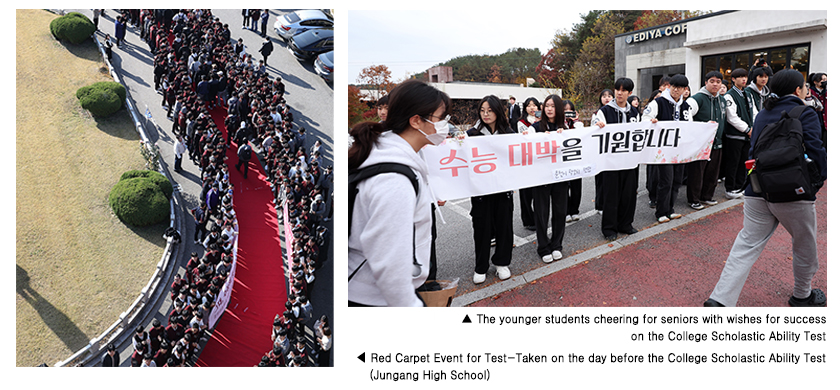
With the elimination of the middle school entrance exam and implementation of the High School Equalization Policy, the intense academic pressure shifted entirely to the college entrance examination. This change resulted in college preparations beginning at an even younger age, with many children starting private lessons and afterschool classes as early as primary school. Furthermore, the abolition of secondary school entrance exams heightened the importance of residing in a desirable school district.
Over the years, the South Korean government has continuously adjusted the country's college entrance system. One of the most significant reforms came in 1991, following recommendations from the Presidential Commission for Education Reform. The Commission proposed replacing the subject-specific College Entrance Achievement Test with a psychometric exam modeled on the U.S. Scholastic Aptitude Test (SAT). This new exam aimed at assessing broader skills rather than specific factual knowledge.
In 1991, the Ministry of Education (MOE) announced a major overhaul of the college admissions process, granting more autonomy to colleges and universities. Institutions could choose from four options for admissions criteria:
1. Use school records alone, with 80% based on academic grades and 20% on extracurricular activities.
2. Combine school records with the new College Scholastic Ability Test (CSAT).
3. Use their own college entrance exams alongside the CSAT.
4. Combine their own exams, the CSAT, and school records.
The CSAT was officially introduced in 1994 and has since become a cornerstone of South Korea’s education system. Aligned with the 7th National Curriculum, the test allows students to choose subjects based on their needs, abilities, interests, and career goals. The CSAT evaluates candidates’ critical thinking and comprehension skills across a range of subjects and is administered annually in November.
On CSAT day, South Korea essentially comes to a standstill.
Government offices and businesses adjust their schedules, thousands of police officers are deployed, flights are restricted, and construction halts to ensure minimal noise and disruption.
The CSAT is so pivotal that it may even be postponed due to natural disasters. Test creation is an intensely secretive process:
high school teachers and university professors work in isolation at remote locations for a month to prevent any leaks.
Centralization to Decentralization: Local Education Self-Governing System of the 5.31 Educational Reform
As discussed above, a large portion of South Korea’s educational system has been operated by the central government, specifically the Ministry of Education. This top-down educational system in Korea was surely one of the primary factors explaining the rapid expansion of schooling and the educational efficiencies in Korea. At the same time, however, this approach of efficiency is one of the primary causes of the drawbacks and problems in Korean education today.The push for decentralization gained momentum following the major educational reform announced on May 31, 1995. Advocates of decentralization sought to establish local school boards to enhance locally governed education while still recognizing the necessity of a strong central Ministry of Education. Their goal was to delegate some authority to elected school boards and superintendents, fostering locally operated educational institutions.
The roots of decentralization in Korea trace back to the American military government between 1945 and 1948. American educators, viewing local community control as a cornerstone of democracy, opposed highly centralized systems, seeing them as susceptible to authoritarian control. They associated such systems with the rise of authoritarian regimes in prewar Germany and Japan. Consequently, Korea’s first Education Law, passed on December 31, 1949, included provisions for school districts and boards of education. However, the implementation of this law was delayed due to the Korean War and the postponed establishment of local self-governance.
Further progress in promoting educational self-governance did not occur until April 1953, when the Enforcement Act for Education Law was adopted. But that progress was limited. Poor management of the Local Education Self-Governance (LESGS), combined with friction between bureaucrats stationed in the Ministry of Education and the Ministry of Home Affairs, triggered harsh criticism of the system. The little progress that had been made came to a halt in 1961, with the outbreak of a military coup. At that point, the Board of Education ceased to function. Previously, 17 locally managed boards of education had been operating in big and small cities and in 123 school districts. In 1961, however, educational administration was absorbed by the general administration and support for the decentralization of the educational system was withdrawn.
A significant shift occurred in 1991, driven by growing demand for local autonomy and political backing. That year, the Regulation for Education Self-Governance was separated from the Education Law, creating the Law for Local Education Self-Governance (LESGS).
This legislation aimed to promote autonomy, professionalism, and regional uniqueness in education. Responsibility for supervising education was transferred to metropolitan and provincial offices headed by superintendents, covering 16 regions (7 metropolitan cities and 9 provinces). However, these boards operated at a broader regional level rather than within smaller local government units.
The LESGS introduced changes to the structure and management of education boards, particularly the selection and qualifications of board members and superintendents. Although these boards were tasked with decision-making, their authority was limited, as metropolitan and provincial assemblies retained control over critical matters such as budgets and taxation. Consequently, decisionmaking power was divided between the boards of education and local assemblies.
The decentralization of education became a central issue in 1995 when the MOE initiated another educational reform. The key challenge was the balance between the self-regulation of autonomous educational bodies and central government oversight.
Since 1995, with the establishment of educational reform, the education system of Korea is composed of three levels of authority:
the Ministry of Education at the central level, 16 metropolitan and provincial offices at the intermediate level, and 180 local offices at the primary level.
The MOE of Korea has the authority to oversee overall school education, lifelong learning, and academic research. Despite decentralization in the 1990s, the MOE still retains strong centralizing power in the educational policymaking process.
At the intermediate level, metropolitan and provincial offices have responsibility for controlling tasks related to education administration but lack the power to develop local education policies or long-term plans. In addition, local governments and education officials are not available to control the higher education institutions in their regions.
In 2007, Korea introduced a direct election system for superintendents and school board members, further decentralizing educational administration. Superintendents, elected every four years, are tasked with enforcing policies within their jurisdictions.
As of 2022, Korea had 17 metropolitan and provincial education offices and 176 district offices, each managing multiple regions.
A distinctive feature of Korea’s superintendent system is its emphasis on political neutrality. Under the Local Education Autonomy Act, candidates for superintendent cannot be affiliated with political parties, and their political ties are not listed on ballots. However, elections often turn into political contests, with candidates aligning themselves with political factions and campaigning accordingly.
Conclusion
The expansion of education in Korea has led to one of the most rigorous and influential testing systems in history. Today, Korea stands as one of the most highly educated nations in the world.Education, seen as the key to social mobility and national progress, remains a cornerstone of Korean society. Despite ongoing debates about the pressures of the system, most Koreans continue to believe in the transformative power of education and value academic credentials as vital to their personal and professional futures. This belief has served to entrench the highly competitive nature of the college entrance examinations.
Moreover, despite ongoing debates, local autonomy in education has been strengthened during Korea's democratization era. Educational policies have become more responsive to public opinion. Korea’s shift to democracy has brought significant changes to its education system, including the development of local educational autonomy, which reflects its democratic progress. With the enactment of the Local Autonomy Law in 1991, the focus of educational administration shifted toward decentralization and democratization.
Regional offices of education now play a more prominent role in addressing local educational issues. The Ministry of Education has transferred much of its decision-making authority, including budget planning and administrative responsibilities, to these local offices. Under the leadership of superintendents elected through general elections, local educational demands and needs can be more effectively identified and addressed.
Education in Korea has long demonstrated its potential to achieve remarkable outcomes, engendering a faith in education’s promise to bring hope and opportunity to everyone. While education in Korea has historically demonstrated its capacity to contribute to a better future, the present moment calls for Korean education to refocus on its fundamental role: creating a better society.
=> Link to the Article, Education in Korea - 1 => Link to the Article, Education in Korea - 2
InfoKOREA 2025
InfoKOREA is a magazine that introduces Korea to readers overseas, including teachers, textbook developers and other educators. The magazine offers the latest statistics on the Republic of Korea and articles that focus on Korean culture, society and history, which can be used as a reference source for textbook writers and editors and as materials for teachers to prepare for class. The theme of the 2025 issue was 'Education in Korea'.
InfoKOREA is a magazine that introduces Korea to readers overseas, including teachers, textbook developers and other educators. The magazine offers the latest statistics on the Republic of Korea and articles that focus on Korean culture, society and history, which can be used as a reference source for textbook writers and editors and as materials for teachers to prepare for class. The theme of the 2025 issue was 'Education in Korea'.

