

Column
Yenniyagi, myths and traditional tales of Korea
In recent years, Korean culture has been a topic of interest in Argentina, particularly in Buenos Aires and other major cities across the country. Korean restaurants have proliferated, many young people have become fans of K-pop groups, festivals and exhibitions are organized, and there is a wide circulation of films and series produced in Korea. However, in the field of education, content about Korea is still not widely available. Curriculum designs, especially those for elementary schools, tend to focus more on local and national issues, and thus do not provide opportunities to include cultural, historical, and geographical knowledge about Korea.
Thanks to the efforts of the Korean Embassy in Argentina, which organizes an annual meeting for representatives of textbook publishers, and the AKS, which provides a wealth of information through its Understanding Korea Project, I was able to develop a link between some of the content in the Argentine primary school curriculum and topics that can facilitate knowledge and understanding of Korean culture in the classroom. Based on this work and having participated in some seminars at the AKS, I discussed this situation with some colleagues, and the idea arose to develop an anthology of traditional Korean stories translated into Spanish so that they could be read by Spanish-speaking children and young people.
The subtitle “Tales from Korea” indicates that these stories come from a region that is very distant for those of us who live in the American continent and arouses curiosity about everything we can discover and learn about Korean culture from these pages. Getting closer to other cultures also means getting closer to their traditional stories, those tales that allow us to access the collective imagination expressed in everyday life through customs, desires, and shared experiences.
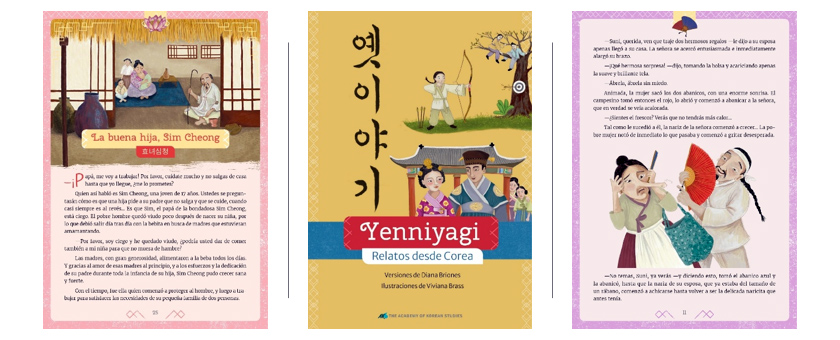
This title became so important to the project that we thought it would be a good idea to have it appear on the cover written in traditional Korean calligraphy, for which we collaborated with Kim Ji Yeon, a Korean-Argentine visual arts designer. We chose the gungche style, with a vertical layout, which captures the traditional and historical spirit of the book.
For the anthology, we chose ten stories—tales, fables, legends, and myths—that speak to us of behaviors, values, and beliefs, and allow us to learn about the ancient origins of many of the characteristics associated with Korean culture today.
We found that some of these stories share common features with tales and fables that are very popular in Europe and America. For example, “Kongjwi and Patjwi” reminds us of Cinderella, whose most popular versions are those by Charles Perrault (France) and the Brothers Grimm (Germany). In the case of “The Hare's Liver,” although the plot is different, the characters remind us of those who appear in the fable attributed to the Greek author Aesop, “The Hare and the Tortoise.” Myths from different cultures are often studied in Argentine schools, especially Greek myths and those of Indigenous peoples. That is why we also included versions of Korean founding myths, such as those of Dangun, Bak Hyeokgose, and Jumong.
We worked from a summary of each of the stories. Diana Briones, a renowned Argentine author of children's literature, wrote the literary versions to ensure a good adaptation for Spanish-speaking audiences. Through intensive research, she was able to describe the landscapes in great detail and give voice to the endearing characters in the stories.
The graphic design by Leda Rensín and the illustrations by Viviana Brass were also created especially for this book, based on careful research so as to ensure that the visual aspect also contributes to providing information about the setting in which the stories take place. The team was assisted by Sofía Maranesi and Gabriela Bing Maneiro, who carried out tasks related to editing, translation, and proofreading.
We hope that Yenniyagi's stories and the complementary teaching proposal will enable children and adults in Spanish-speaking countries to travel with their imagination to fascinating Korea, to enrich themselves with its history and to give new meaning to everything we know about contemporary Korean culture, promoting meaningful learning and a transformative cultural experience in the classroom.
Thanks to the efforts of the Korean Embassy in Argentina, which organizes an annual meeting for representatives of textbook publishers, and the AKS, which provides a wealth of information through its Understanding Korea Project, I was able to develop a link between some of the content in the Argentine primary school curriculum and topics that can facilitate knowledge and understanding of Korean culture in the classroom. Based on this work and having participated in some seminars at the AKS, I discussed this situation with some colleagues, and the idea arose to develop an anthology of traditional Korean stories translated into Spanish so that they could be read by Spanish-speaking children and young people.
The title
The title of the book, “Yenniyagi,” in Romanized Korean, means “ancient stories.” It is the transcription into the Latin alphabet of the Korean pronunciation of ‘옛이야기’. Although this type of material is usually titled with descriptive expressions such as “old tales” or “traditional tales,” we found an original title that used a Korean word written in the Latin alphabet so that all readers could access it, understand it, and incorporate it into their vocabulary.The subtitle “Tales from Korea” indicates that these stories come from a region that is very distant for those of us who live in the American continent and arouses curiosity about everything we can discover and learn about Korean culture from these pages. Getting closer to other cultures also means getting closer to their traditional stories, those tales that allow us to access the collective imagination expressed in everyday life through customs, desires, and shared experiences.
This title became so important to the project that we thought it would be a good idea to have it appear on the cover written in traditional Korean calligraphy, for which we collaborated with Kim Ji Yeon, a Korean-Argentine visual arts designer. We chose the gungche style, with a vertical layout, which captures the traditional and historical spirit of the book.
The selection of stories and adaptation
The subtitle “Tales from Korea” indicates that these stories come from a region that is very distant for those of us who live in the American continent and arouses curiosity about everything we can discover and learn about Korean culture from these pages. Getting closer to other cultures also means getting closer to their traditional stories, those tales that allow us to access the collective imagination expressed in everyday life through customs, desires, and shared experiences.For the anthology, we chose ten stories—tales, fables, legends, and myths—that speak to us of behaviors, values, and beliefs, and allow us to learn about the ancient origins of many of the characteristics associated with Korean culture today.
We found that some of these stories share common features with tales and fables that are very popular in Europe and America. For example, “Kongjwi and Patjwi” reminds us of Cinderella, whose most popular versions are those by Charles Perrault (France) and the Brothers Grimm (Germany). In the case of “The Hare's Liver,” although the plot is different, the characters remind us of those who appear in the fable attributed to the Greek author Aesop, “The Hare and the Tortoise.” Myths from different cultures are often studied in Argentine schools, especially Greek myths and those of Indigenous peoples. That is why we also included versions of Korean founding myths, such as those of Dangun, Bak Hyeokgose, and Jumong.
We worked from a summary of each of the stories. Diana Briones, a renowned Argentine author of children's literature, wrote the literary versions to ensure a good adaptation for Spanish-speaking audiences. Through intensive research, she was able to describe the landscapes in great detail and give voice to the endearing characters in the stories.
The graphic design by Leda Rensín and the illustrations by Viviana Brass were also created especially for this book, based on careful research so as to ensure that the visual aspect also contributes to providing information about the setting in which the stories take place. The team was assisted by Sofía Maranesi and Gabriela Bing Maneiro, who carried out tasks related to editing, translation, and proofreading.
The teaching guide
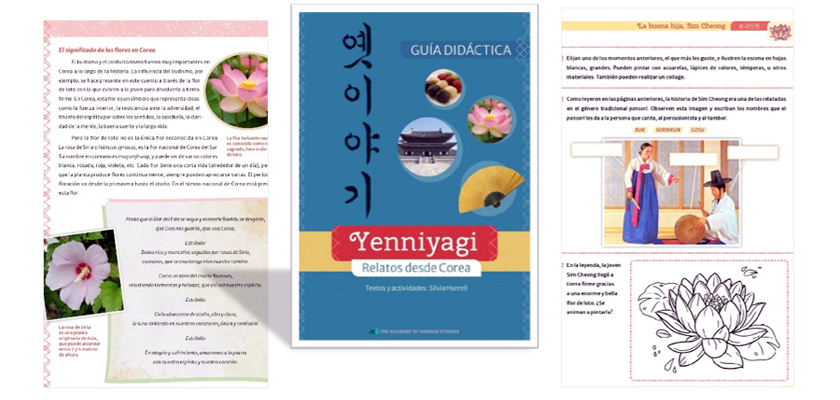
As specialists in the publication of school textbooks, we know that teachers make use of all those materials that support working with literature in the classroom. The teaching guide was designed by educator Silvia Hurrell as a tool to enrich classes, providing a framework for exploring and enjoying these stories from multiple perspectives. By providing information on the cultural, historical, and geographical context in which the stories originated, it helps readers to understand their relevance and give meaning to their teachings. It also includes a variety of activities that encourage critical thinking, group discussion, and student creativity, inviting readers to relate the stories to their own experiences, explore values such as perseverance, honesty, and respect, and give free rein to their imagination through literary and artistic exercises.Audio stories
Traditional ancient literature consists of anonymous texts that were passed down through generations, many of them orally. In a way, we recreate this form of circulation through the production of audio stories, recorded and narrated tales that offer an alternative way of learning about these stories, allowing for the inclusion of those who cannot access the written text.The circulation and impact of the project
The digital book, in PDF and E-pub formats, the teaching guide, and the audio stories are available to download for free on the website https://linktr.ee/yenniyagi for anyone interested in the subject. So far, the material has been reviewed by Argentina's Honorary Reporter María Fernanda Urrutia on the korea.net website. Recently, it has also been added to the Biblioteca País (Country Library) of Plan Ceibal, the educational platform of Uruguay.We hope that Yenniyagi's stories and the complementary teaching proposal will enable children and adults in Spanish-speaking countries to travel with their imagination to fascinating Korea, to enrich themselves with its history and to give new meaning to everything we know about contemporary Korean culture, promoting meaningful learning and a transformative cultural experience in the classroom.

