

Column
Meeting Korean American Immigration History Through Film

Jinyoung Lee
(Film Director, Founding Producer of NOW Production Films)
I‘m often asked, “Why did you start making films about Korean American immigration history?” Whenever I hear that question, one person always comes to mind: the late Chairman Donald Chang Won Kim, whom I met during my time as a broadcast journalist. He started as an entry-level employee at a construction company in Hawai’i and rose to become chairman, served as the first Korean American trustee of a state university, and established Hawai’i’s first Korean bank. He was one of the most respected elders in the Korean American community. At the end of our interview, I carefully asked what had driven him to maintain such extensive philanthropy and community involvement throughout his life. I remember his answer vividly even today.
“From adulthood until now, past seventy, not a single day has passed when I’ve forgotten the blood and sweat our immigrant ancestors shed in Hawai’i. I think of those who sent funds to support the independence movement back home even while working ten-hour days. The comfortable lives we enjoy today would have been impossible without their sacrifices. Sharing what I have for the next generation, for the world young people will live in—that’s both the duty and responsibility of being an elder.”
Chairman Kim lived during the same era as Hawai’i’s first-generation immigrants. His father sailed on one of the early immigrant ships, and the ancestors who worked on sugar plantations were the neighboring grandmas and grandpas. That day, I first truly understood the debt we owe to history and our responsibility to repay it. Our ancestors used wages earned on sugar plantations to support the independence movement and helped rebuild a homeland devastated by war, including establishing universities. The democracy and prosperity we enjoy today are the fruits of those efforts.
The films Words of Wisdom from the Rainbow State (2021) and Songs of Love from Hawai’i (2024), produced by our nonprofit film company, are based on the historic journey of 121 Koreans who left for Hawai’i in 1902 to work as sugar plantation laborers. Their courage became not just the life of a single generation but the starting point of today’s Korean diaspora of approximately seven million people.
As Korean culture has spread globally in recent years, the need to deliver Korean history and culture through educational means has grown. However, the films students seek out in theaters are primarily Hollywood blockbusters. When we screened both films at universities and high schools in the United States and Korea, students were surprisingly moved by their ancestors’ lives. Many Korean language school teachers expressed regret, saying, “We want to show this to our students, but we don’t have budget for screening fees.”
This led me to envision a free online educational platform for use in educational settings. Then, in 2024, I was selected for the Academy of Korean Studies’ “Understanding Korea Grant,” which allowed me to pursue this in earnest.
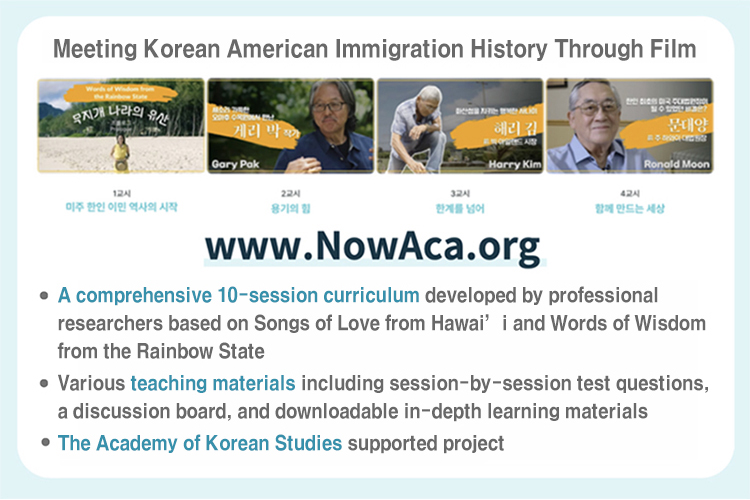
NOW Academy (www.NowAca.org) is a platform centered on our film company’s two works, creating an educational website and e-book that can be utilized in educational settings worldwide. As a result, it received this evaluation from the Academy of Korean Studies: “It conveys the history and current situation of Koreans who migrated to Hawai’i in an accessible way, and should prove highly valuable in practice.”
The platform officially launched in September 2025 at a lecture for the American Association of Teachers of Korean held in Hawai’i, and has since been implemented in actual classes at elementary and secondary schools across North America and various educational institutions in Korea, establishing itself as an immigration history education platform.
“From adulthood until now, past seventy, not a single day has passed when I’ve forgotten the blood and sweat our immigrant ancestors shed in Hawai’i. I think of those who sent funds to support the independence movement back home even while working ten-hour days. The comfortable lives we enjoy today would have been impossible without their sacrifices. Sharing what I have for the next generation, for the world young people will live in—that’s both the duty and responsibility of being an elder.”
Chairman Kim lived during the same era as Hawai’i’s first-generation immigrants. His father sailed on one of the early immigrant ships, and the ancestors who worked on sugar plantations were the neighboring grandmas and grandpas. That day, I first truly understood the debt we owe to history and our responsibility to repay it. Our ancestors used wages earned on sugar plantations to support the independence movement and helped rebuild a homeland devastated by war, including establishing universities. The democracy and prosperity we enjoy today are the fruits of those efforts.
The films Words of Wisdom from the Rainbow State (2021) and Songs of Love from Hawai’i (2024), produced by our nonprofit film company, are based on the historic journey of 121 Koreans who left for Hawai’i in 1902 to work as sugar plantation laborers. Their courage became not just the life of a single generation but the starting point of today’s Korean diaspora of approximately seven million people.
As Korean culture has spread globally in recent years, the need to deliver Korean history and culture through educational means has grown. However, the films students seek out in theaters are primarily Hollywood blockbusters. When we screened both films at universities and high schools in the United States and Korea, students were surprisingly moved by their ancestors’ lives. Many Korean language school teachers expressed regret, saying, “We want to show this to our students, but we don’t have budget for screening fees.”
This led me to envision a free online educational platform for use in educational settings. Then, in 2024, I was selected for the Academy of Korean Studies’ “Understanding Korea Grant,” which allowed me to pursue this in earnest.
NOW Academy (www.NowAca.org) is a platform centered on our film company’s two works, creating an educational website and e-book that can be utilized in educational settings worldwide. As a result, it received this evaluation from the Academy of Korean Studies: “It conveys the history and current situation of Koreans who migrated to Hawai’i in an accessible way, and should prove highly valuable in practice.”
The platform officially launched in September 2025 at a lecture for the American Association of Teachers of Korean held in Hawai’i, and has since been implemented in actual classes at elementary and secondary schools across North America and various educational institutions in Korea, establishing itself as an immigration history education platform.
1. Multi-Dimensional Class Structure Built Around Two Films1
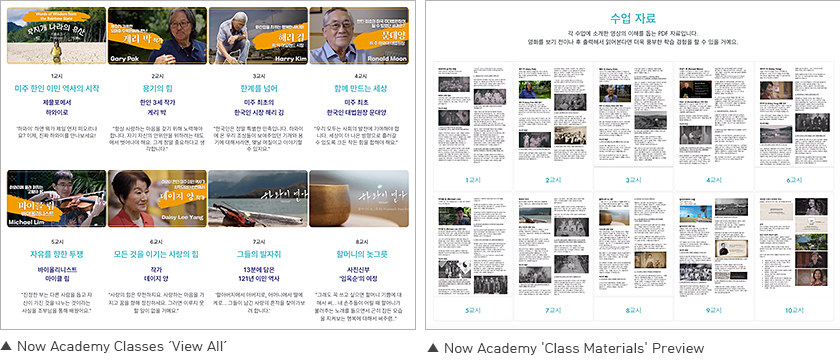
I designed NOW Academy as a 10-session curriculum with the goal of providing students with a “multi-dimensional learning experience” that goes beyond simply watching films. Each lesson includes edited video clips ready for classroom use, learning objectives, and historical background explanations, as well as discussion topics and quizzes that encourage students’ independent thinking. On the website, these elements are clearly organized into sections like “Class Video,” “Lesson Objectives,” “Historical Information,” and “Discussion Points” for easy reference, and we’ve also created an e-book with the same structure that can be used in offline environments without internet access.The overall curriculum is designed progressively based on the narratives of both films. Sessions 1-6 center on the six-part documentary Words of Wisdom from the Rainbow State, exploring experiences and insights shared by five descendants of early immigrants who excelled in various fields, including the first Korean American mayor and state supreme court justice. Through this, students can naturally understand the meaning that the efforts and sacrifices of first-generation immigrants left for today’s community and individual identity.
The subsequent sessions 7-10 focus on Songs of Love from Hawai’i, exploring the life of picture bride Lim Ok Soon and the history of Kalaupapa Island, known as “Hawai’i’s Sorokdo,” refering to Korea’s island leper colony. All content is provided in both Korean and English, allowing immediate use in overseas educational settings without separate translation processes. It was most important to me to create a structure where students experience history through film, ask questions, discuss, and create meaning for themselves.
For this project, as a producer, director, and writer overseeing the entire effort, I worked closely with various domestic and international experts to encompass both field experience and academic rigor. Our international research team included Daniel Suehisa, teacher at Kalihi Kai Elementary School in Hawai’i; history communicator Tae Sung Choi; Dr. Jean Young Lee, Professor and Director of the Center for International Studies at Inha University; and Dr. Diana Kim, Associate Professor in the School of Foreign Service at Georgetown University, allowing us to strengthen the content’s academic depth and global applicability. Additionally, Becca Bae, distribution and production manager at NOW Production, oversaw the planning of an intuitive yet sophisticated design, leading to the creation of an environment where both teachers and students could naturally interact with and learn from the platform. As a result, we were able to implement a student-participation-centered, interactive learning experience that goes beyond simply providing materials.
2. Positive Response and Expansion in Educational Settings
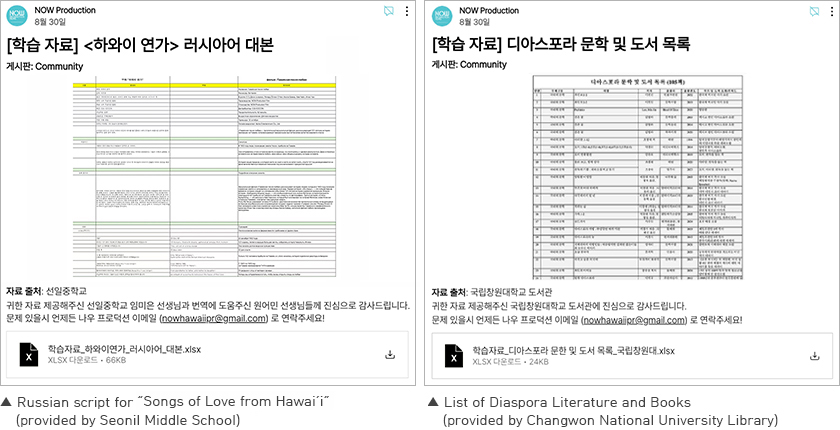
Since the platform’s launch, the response from educational institutions has been spreading faster than expected. As a lecturer, I conduct presentations in various regions domestically and internationally, and I always introduce NOW Academy during immigration history lectures hosted by education offices. Teachers’ responses have been very positive, and many schools are actively utilizing NOW Academy in after-school or project-based classes. This past October, the platform has been actively used by Korean language professors at George Washington University and Indiana University, as well as at Korean language schools in the Washington area. And, in January 2026, I’m scheduled to introduce historical research methods through NOW Academy at a teacher training session hosted by the Gangwon State Office of Education.Within NOW Academy’s “Community” feature, educators worldwide are actively sharing class implementation cases and experiences. For example, a native speaker teacher at Seonil Middle School in Ansan, an area with a concentrated ethnic Korean (Koryo-saram) population, translated Songs of Love from Hawai’i into Russian and shared it on the community board for anyone to use. In this way, NOW Academy has established itself as a communication space connecting teachers and students worldwide, going beyond simply providing online materials. I plan to keep working to help the content reach audiences across different languages and regions.
Closing Remarks
I’ve always wanted to share our proud Korean immigration history with more students in a fun and engaging way. The NOW Academy project is meaningful to me because it goes beyond creating learning materials to implement a new form of educational platform where students can directly see, hear, discuss, and experience historical events. Furthermore, it’s especially meaningful that through this project, I can contribute to the larger goal of “globalizing K-content.”This project was made possible thanks to its selection for the Academy of Korean Studies’ “Understanding Korea Grant.” Thanks to the academy’s generous support and trust, we were able to build a platform with both educational value and practical field applicability, and for this, I’m deeply grateful.
Going forward, I plan to continue collaboration with educators and students worldwide through NOW Academy. I want to transform Korean immigration history and Korean culture from mere information delivery into an educational experience that students can connect to their own lives. Additionally, my goal is to create opportunities for content to be naturally shared across various languages and regions, and for students from different cultural backgrounds to understand the Korean diaspora and Korean history more deeply. I sincerely hope that this platform will reach more classrooms and educational settings, allowing students to viscerally feel our ancestors’ sacrifices and courage through the process of asking questions, discussing, and learning for themselves.

